Physical Address
304 North Cardinal St.
Dorchester Center, MA 02124
Physical Address
304 North Cardinal St.
Dorchester Center, MA 02124
Helpful ideas. Squeaky value.
Helpful ideas. Squeaky value.
I recently heard a story of two girls and their cookie business. The first girl bakes a few dozen chocolate chip cookies and goes door-to-door to sell them. She finds selling the cookies difficult because not everyone likes or wants chocolate chip. Some like oatmeal raisin. Some like peanut butter. On top of that, a dozen is a lot. Some only want six.
The other girl decides that before baking cookies, she’ll go door-to-door and ask the neighbors what they want, taking orders specific to their needs. She then buys the ingredients she needs for each order, bakes the cookies, and delivers them to satisfied customers.
The first girl committed all of her resources to a product that many didn’t need or want. The second was able to manage her resources by committing them to a product that customers did want.
There’s a lesson in this for e-learning course designers.
Most training courses follow the first girl’s model. A subject matter expert hands over a content deck. We organize it, add some interactivity, publish it, and get it out the door. At some point everyone wonders why the training didn’t work.
We committed all our resources to something nobody asked for. Or asked for in the wrong way. With some standard performance consulting this could be prevented. The main problem is a common problem: the course is built around information, not around how anyone will use it.
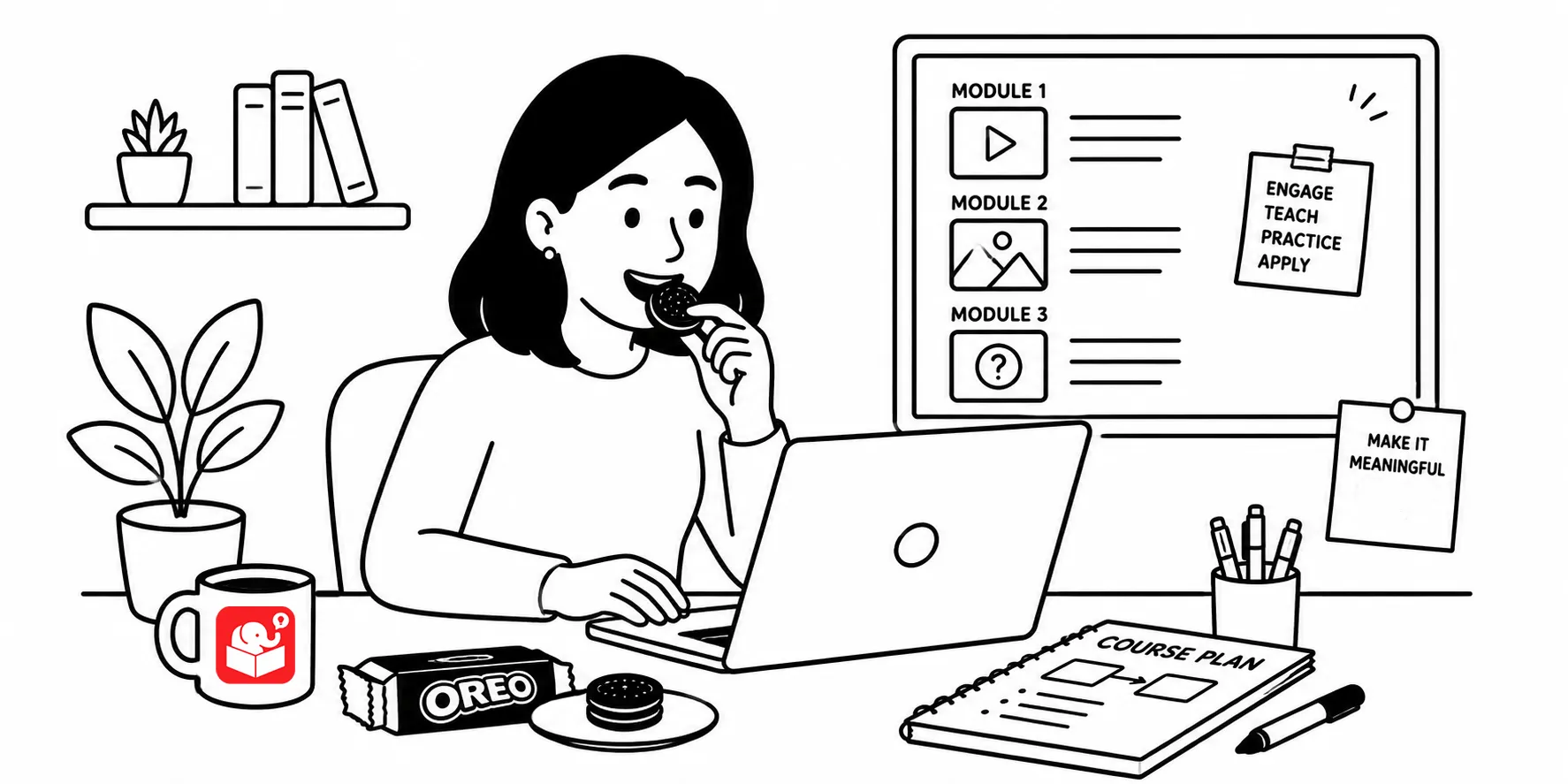
Sticking with the cookie theme, here’s the OREO acronym I came up with. It isn’t the most technical acronym. But it sticks. It covers the four things that matter most when you’re building training that does something useful.
Here’s what each letter means in practice.
Don’t just build training based on content you have. Be like the second girl, find out what learners need to do on the job. Talk to people in the role. Watch them work. Ask what trips them up. The course you design after that conversation will look different from one built off a content dump.
Organizations pay for training courses because they expect something to change. Design the course around that change. What should learners do differently 30 days after the course? Start there, then work back to the content that supports it. Cut anything that doesn’t serve the result.
Engagement isn’t just visual polish, though that matters. It means getting learners to make decisions. Real decisions. The kind they’d face on the job. A scenario where someone picks the wrong answer and sees the consequence is worth ten slides of bullets. Build practice that mirrors the real world.
Make a promise to your learners: this course won’t waste your time. That promise lives in the objectives. Be specific about what learners will be able to do when they finish. Build every part of the course to deliver on it. If a section doesn’t serve an objective, cut it.
You don’t have to overhaul your entire process at once. On your next project, try spending 30 minutes with someone in the learner’s role before you open a slide deck. Ask what they actually struggle with. Let that shape your objectives. Then check your draft against the real-world result you’re trying to drive.
Even a small shift toward taking orders first will produce a better course.