Physical Address
304 North Cardinal St.
Dorchester Center, MA 02124
Physical Address
304 North Cardinal St.
Dorchester Center, MA 02124
Helpful ideas. Squeaky value.
Helpful ideas. Squeaky value.

When it comes to e-learning, I often like to start with “throwing people in the pool” to see if they can swim. Most people already come to the course with some level of knowlegde or they at least can make an educated guess in trying to solve a problem.
As they work through activities they form hypothesis and also begin to understand their gaps. In addition, depending on the training it could also expose the critical nature of the gaps caused by not knowing.
That’s the core idea behind the HAT model.
The typical e-learning course opens with objectives, moves through screens of content, and saves the activity for the end. Learners absorb (or don’t absorb) the information and then try to apply it. By then, many have tuned out. The course treats practice as a reward for sitting through content, rather than a tool for building understanding.
HAT stands for Hands-on activity, Advice, and Tell. The sequence reverses the usual order and puts the learner in motion from the start.
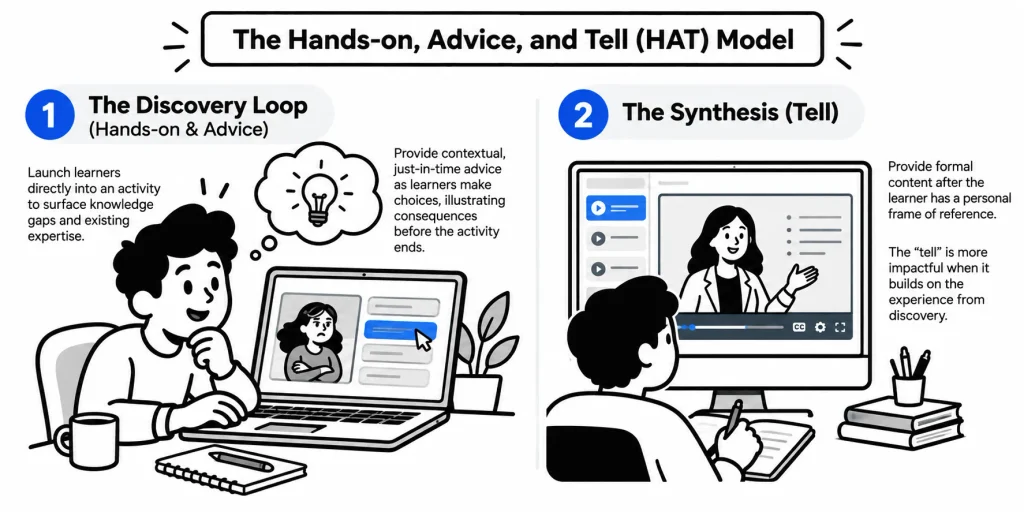
Here’s how each stage works:
The activity-first approach isn’t always an easy sell. Some clients want every bullet point presented in order before anyone touches an activity. It feels safer. But that preference usually comes from a focus on covering content rather than building competence.
Your job as a designer is to shift the conversation from “did they see it?” to “can they do it?”
The HAT model is a useful alternative whenever you’re designing a course that needs to do more than inform. It works well for performance-based training, onboarding, and any scenario where learners arrive with different experience levels. The next time a client asks you to build another linear presentation course, try presenting this model. Show them what an activity-first approach looks like in a short prototype, and see if the conversation changes.