Physical Address
304 North Cardinal St.
Dorchester Center, MA 02124
Physical Address
304 North Cardinal St.
Dorchester Center, MA 02124
Helpful ideas. Squeaky value.
Helpful ideas. Squeaky value.
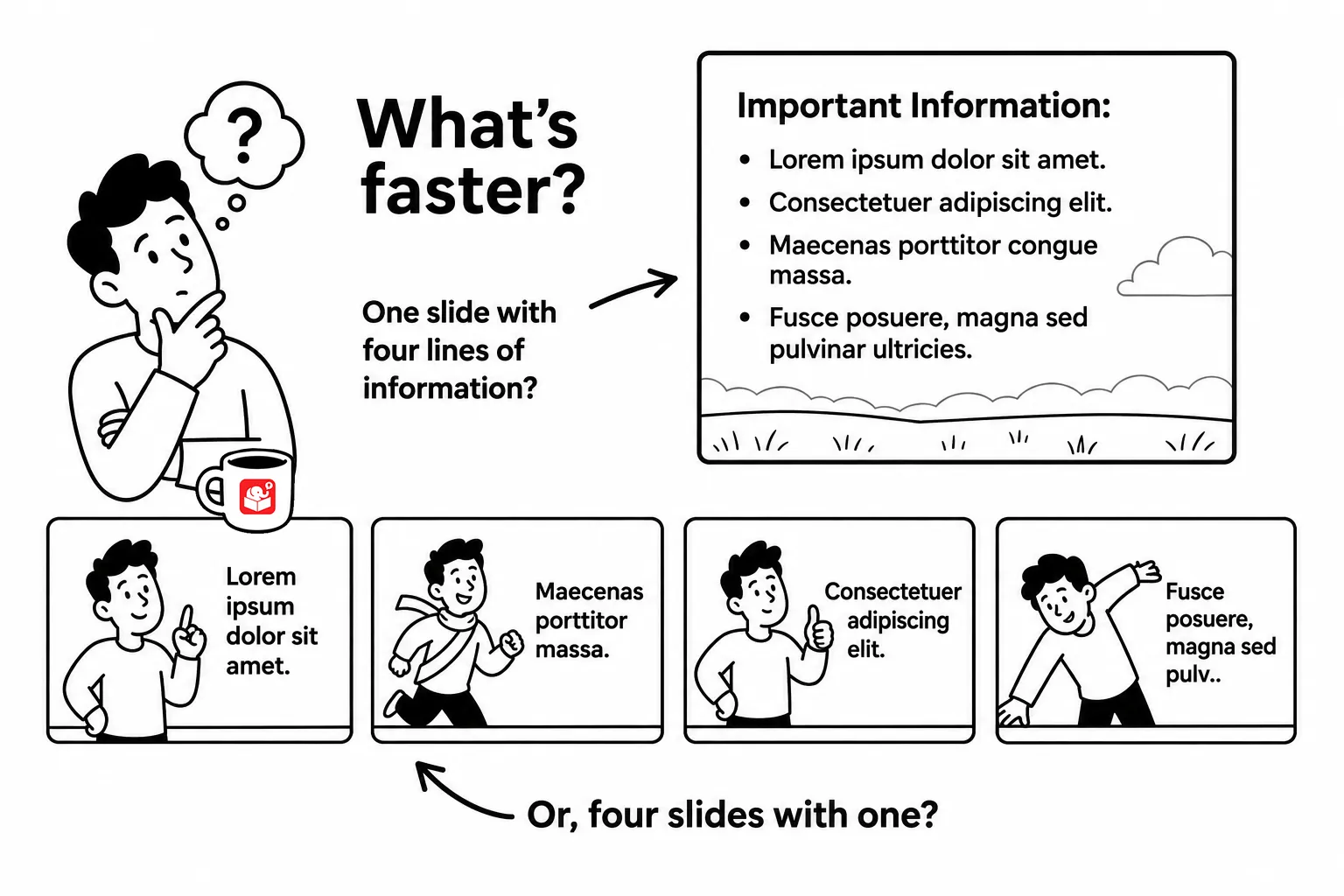
I get a lot of questions about number of slides or screen count per hour of instruction. My answer is that screen count is usually irrelevant. Let me explain.
Picture putting five facts on a single slide versus spreading those same five facts across five separate slides. From the learner’s perspective, the experience is nearly identical. The information is the same either way.
Slide count is a production metric, not a learning metric. It tracks what went into the course, not what came out of it.
Focusing on count keeps your attention in the wrong place.
A course should last long enough to meet its objectives. That’s the only useful length measurement. If you can meet your objectives in ten slides, build ten. If it takes forty, build forty.
Start with the end in mind. What do learners need to be able to do after the course? Work backward from that. Let the objectives determine the structure, and let the structure determine the slide count.
Add branching navigation to a course and slide count becomes almost entirely disconnected from learning time. A learner moving through a scenario might see three slides or thirty, depending on the choices they make.
What matters in that case isn’t the total number of slides in the file. It’s whether the decisions they’re practicing map to real situations they’ll face. Count has nothing to do with that.
Slide count debates will keep happening, but you don’t have to let them drive your design decisions. The next time someone asks how many slides a course needs, ask what problem it’s solving first. The answer to that question is the only one that actually matters.