Physical Address
304 North Cardinal St.
Dorchester Center, MA 02124
Physical Address
304 North Cardinal St.
Dorchester Center, MA 02124
Helpful ideas. Squeaky value.
Helpful ideas. Squeaky value.
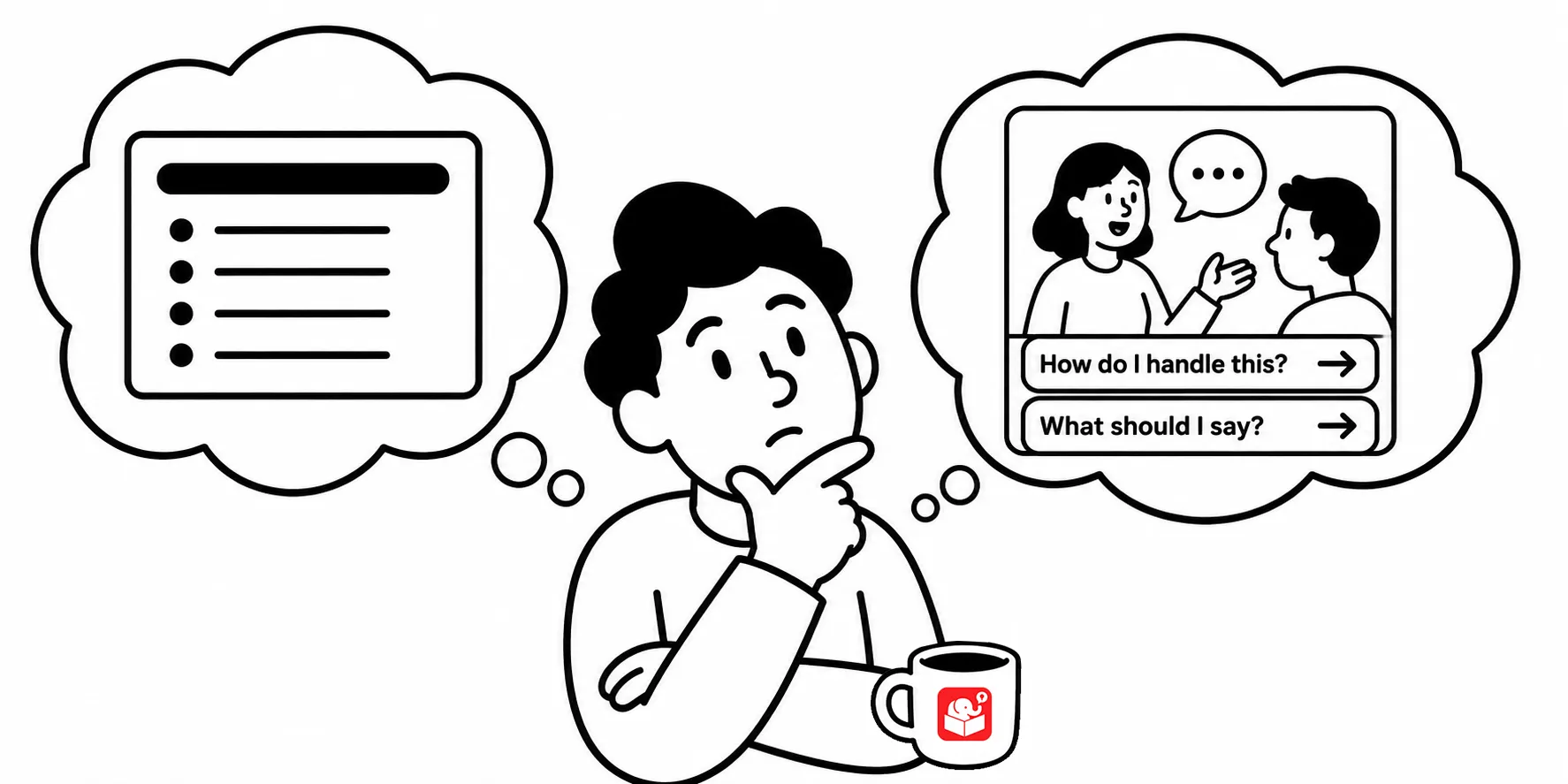
The most common question I hear from e-learning developers is how to make courses more engaging. When I ask what they have in mind, the answer is almost always the same: less click-and-read and more branching. That answer reveals a common misunderstanding.
When developers say “click-and-read,” they mean linear back-and-forward navigation. That’s common in e-learning. And it gets mocked and a bad rap.
What’s also common in linear courses is screen after screen of bullet points. People tend to assume the two are connected. They think linear navigation means endless bullet points which means boring courses.
When they talk about branching, they picture something more interactive. The learner makes a choice and gets feedback specific to that choice. There are fewer bullet points because the screen layouts are different.
Here’s the reality. Whether a course is linear or branched, the user experience is fundamentally the same. The learner clicks something and sees content. They don’t know if they’ve moved to the next slide in a sequence or jumped somewhere else. They don’t care either. Navigation type alone doesn’t make a course engaging.
I’m not saying that they are the same. What I’m saying is that linear versus branching isn’t necessarily equal to bad versus good.
What they’re really asking, is how do I make my courses more engaging. The truth is that a lot of e-learning is boring and probably for many learners, pointless.
At it’s core, engagement comes from relevance. If the content connects to the learner’s work, they’ll stay with it. If it doesn’t, no navigation pattern will save it. So converting an irrelevant and meaningless course from linear to some sort of branching activity isn’t the solution.
Here are five approaches that make a real difference.
If the content doesn’t connect to what learners do at work, they’ll disengage. That’s true for any course, no matter how it’s built. Relevance is the foundation. It’s also what most click-and-read courses are missing.
Questions are a simple and effective structure. Use a question as a screen heading. Restructure the whole course like a FAQ. Build branched interactions where experts follow one path and beginners follow another. Questions force the content into a more useful shape and reframes the content from a question that has meaning and needs to be answered.
“How do you deal with angry customers?” That already gets someone thinking.
When someone faces a problem at work, they make a decision. They don’t look up the policy first. But many courses lead with policy and never put the learner in a situation where it matters.
Build scenarios where learners face real decisions. Let them make mistakes. Give them feedback that explains the consequence. That’s a better way to teach a policy than listing rules. I like the 3C model as an easy way to think about interactive scenarios.
E-learning doesn’t have to be a solo experience. Use it alongside team activities or group discussions. The course delivers content consistently. Human interaction adds depth that a course alone can’t provide.
The e-learning course is part of the solution to deliver training. How a person learns is more than the course. Being connected to their daily routines and peer coaches is a solid move.
Some courses will never feel relevant to every learner who takes them. Compliance training is the obvious example. In those cases, don’t overbuild. Give learners what they need and help them finish quickly. Adding games and interactions to irrelevant content doesn’t help.
The next time someone asks for more branching, ask what problem they’re trying to solve. Branching is a useful tool, but it’s not a fix for content that doesn’t connect. Start with relevance. Build around real decisions learners face. Then choose the navigation structure that best supports that experience.