Physical Address
304 North Cardinal St.
Dorchester Center, MA 02124
Physical Address
304 North Cardinal St.
Dorchester Center, MA 02124
Helpful ideas. Squeaky value.
Helpful ideas. Squeaky value.
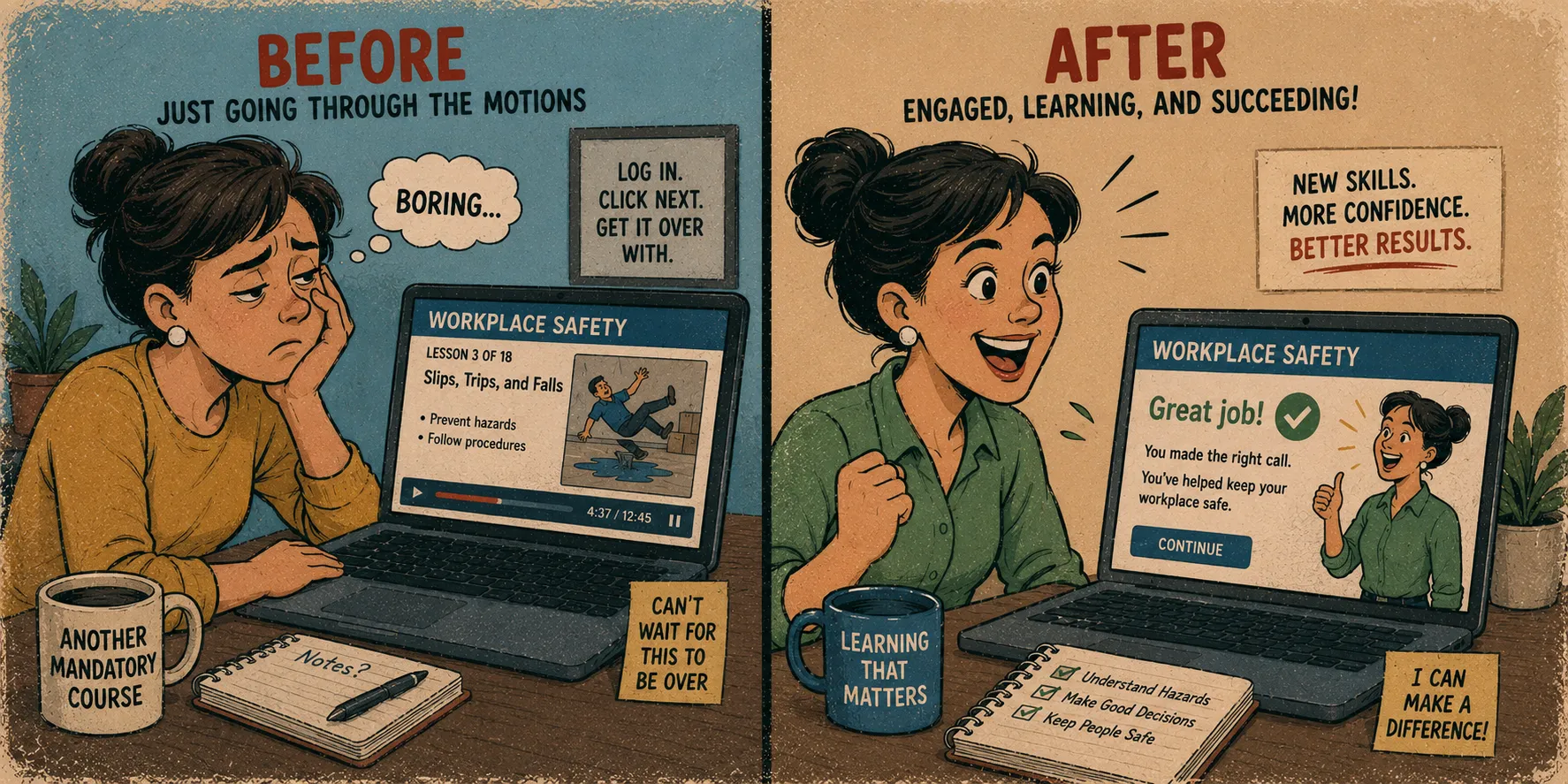
Many of us have to take annual e-learning courses. And to be honest, while they serve a purpose, they’re mostly irrelevant to what we do on a daily basis. Because of this we tend to tune out or do the bare minimum required to complete the course and go back to work.
I’m sure if I was a pilot in training, I wouldn’t tune out while in a flight simulator. When I was in basic training and had to throw a real grenade, I didn’t tune out what they were teaching us. That training was meaningful and could have bad results if neglected.
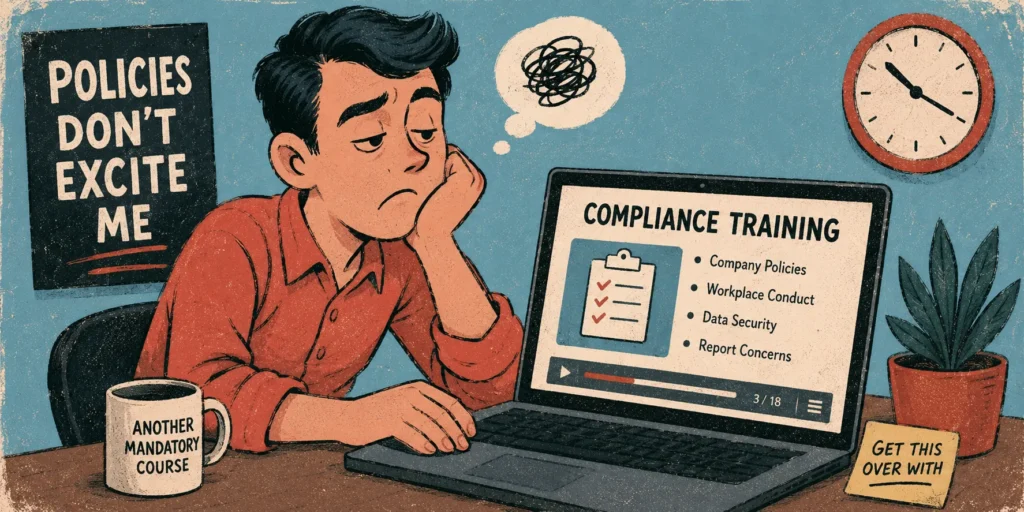
When it comes to e-learning, you can fill a course with useful information, but you can’t make anyone learn it. Learners decide how much attention and effort they will give you. Because of this your job is more than content construction. You need to make that effort they put into the course feel worthwhile by connecting the course to something they care about or need to do.
Think about the last time you really wanted to learn something. Maybe it helped you solve a problem, earn more money, avoid an embarrassing mistake, or stay safe. The topic mattered because the outcome mattered.

As I mentioned earlier, I learned this in a memorable way during military basic training. I worked in Finance, so people normally trusted us with little more than a pencil. Still, I got one chance to throw a live grenade.
Before anyone handed me that grenade, I went through practice sessions and safety procedures. I paid really close attention because the consequences were easy to understand. Most e-learning courses don’t come with that level of urgency, so course builders need to find another reason for learners to care.
Learners usually ask a simple question before they begin: What’s in this for me? They may not say it out loud, but the answer shapes how they approach the course. If they don’t see a benefit, they will probably give the course the least amount of effort needed to finish it.
Don’t make people wait until the final screen to discover why the content matters. Tell them what the course will help them do, avoid, decide, or improve. Then keep that value visible as they move through the experience.
A course feels more useful when learners can see how it helps them perform. That doesn’t mean every screen needs a complex interaction. It means the examples, decisions, and practice activities should look like the work people actually do.
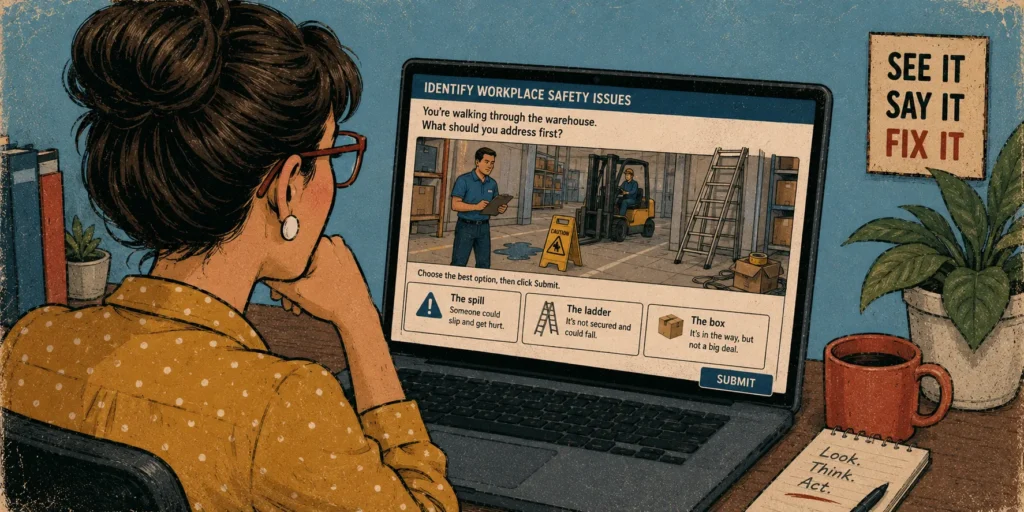
For example, a typical site safety course could end with a few multiple-choice questions about procedures. That checks recall, but it doesn’t show whether someone can spot a hazard or choose the right response. However, a short scenario built around a realistic worksite gives the learner a better reason to think and gives you better evidence of what they can do.
As you review your course, look for places where generic content can become more concrete. You might:
Confusion drains motivation. If learners don’t know where they are, what they should do, or how long the course will take, they spend their energy figuring out the course instead of learning from it.
You don’t need a long tutorial that explains how to click the Next button. But you do need a course that behaves the way people expect. Keep the navigation consistent, make instructions specific, and tell learners what success looks like.
A little clarity goes a long way. Before the course begins, answer the questions learners are likely to have:
Rewards can help, but they don’t have to be prizes or merchandise. Often, the best reward is a clear sense that the learner is getting somewhere. A useful challenge, a chance to test out, or simple feedback can make progress feel real.
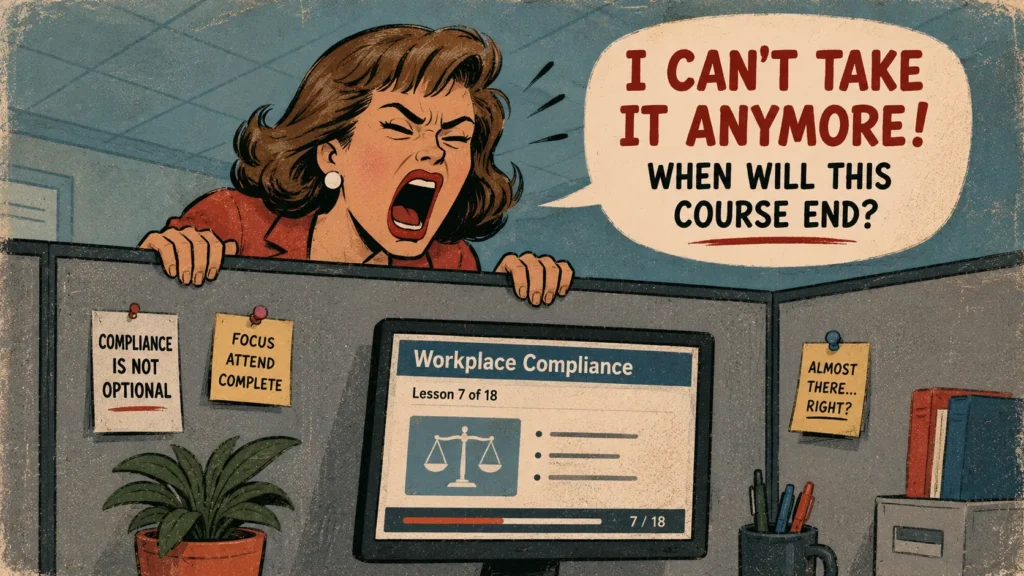
Match the reward to the course. A badge may work in one setting and feel childish in another. Sometimes the most respectful option is to let experienced learners prove what they know and skip content they don’t need.
Look for small moments where the course can acknowledge effort or improvement. You might show progress toward a goal, provide encouraging feedback after a difficult decision, or let learners compare an early attempt with a later one.
People pay attention when something challenges their assumptions. A surprising fact, a common mistake, or a realistic dilemma can create just enough tension to make learners curious about the answer.
I created a simple model to teach how to build intertactive scenarios about 30 years ago. I call it the 3C mode: challenge, choices, consequencs. It’s an easy way to think through your content.
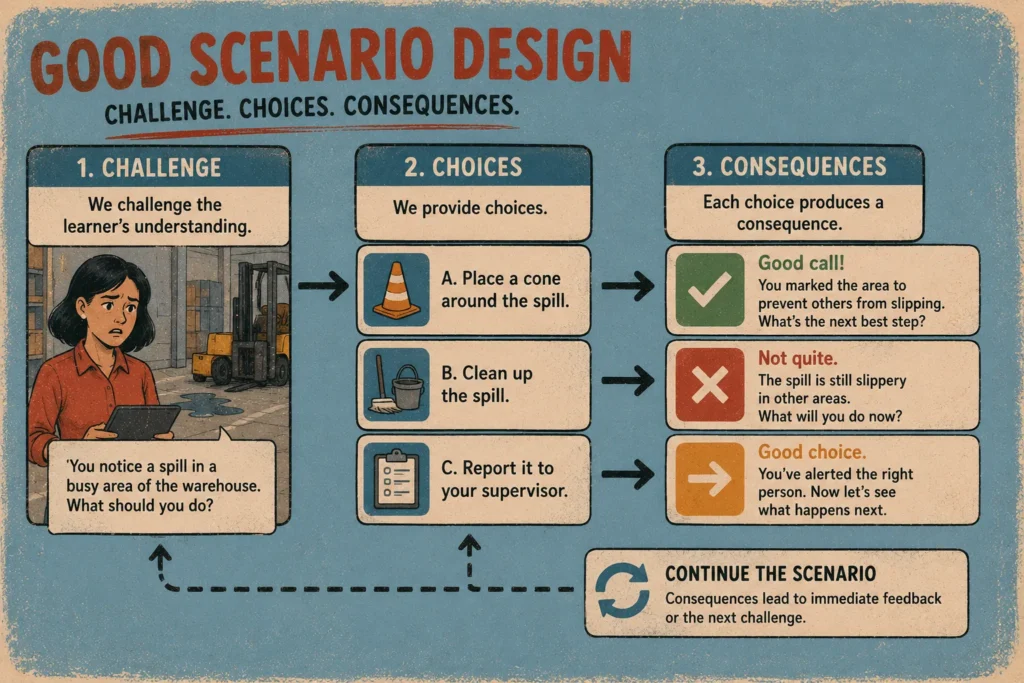
You don’t need to provoke people for the sake of it. The point is to make them stop and think. The challenge isn’t a quiz question to prove them right or wrong. Ask a question that exposes a misconception, let them choose what they would do, and then show the consequences of that choice.
This works best when learners can fail safely. A course gives people room to make a bad decision, see what happens, and try again without the cost of making that mistake at work. That kind of challenge feels more meaningful than clicking through a series of facts.
You don’t need to rebuild every course you did in the past, but you can start fresh with a new one. Start with one lesson and find one place where learners need a stronger reason to care. Then make a small change and see how people respond.
For your next project, try this simple approach:
Watchout for this gotcha: new course builders often focus first on graphics and interactions because those are easy to see and give the appearance of value. This is even truer today with quick AI content.
Motivation is less visible, but it has a bigger effect on whether the course works. When learners understand the value, recognize the work, and know what to do, you don’t have to force engagement. You give it a reason to happen.
You can’t control whether someone learns, but you can design a course that gives them a reason to try. Show the value early, connect the content to real work, reduce frustration, make progress visible, and create safe ways to test assumptions.
In your next course, choose one lesson, improve one of those areas, and use learner feedback to decide what to change next.
Comments are closed.




[…] I said: stop. Let’s focus on the types of decisions a person needs to make using this content in the real world. What we need to do is work with their current level of […]