Physical Address
304 North Cardinal St.
Dorchester Center, MA 02124
Physical Address
304 North Cardinal St.
Dorchester Center, MA 02124
Helpful ideas. Squeaky value.
Helpful ideas. Squeaky value.
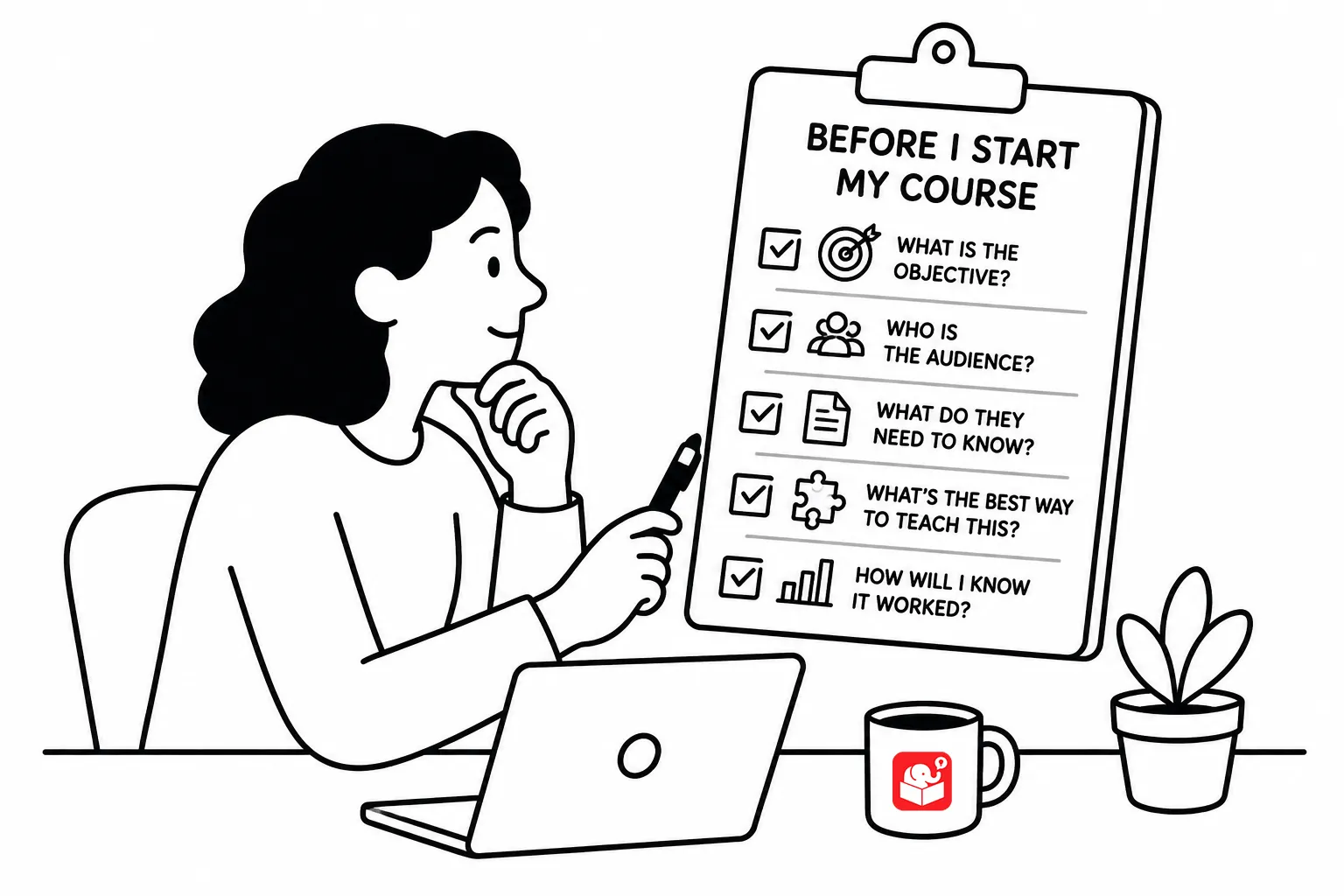
On a recent flight, I watched the crew run through a pre-flight checklist before takeoff. I assume it covered a series of items that had to be confirmed before the flight could leave. That’s a ritual is worth borrowing for e-learning.
What would be in your pre-flight checklist? Here are some of mine.
Work through these questions at the start of any project. They surface the issues that are much harder to fix once you’re deep into production.
Some courses exist to change behavior and build new skills. Others cover awareness or satisfy a certification requirement. Knowing which type you’re building shapes every decision that follows.
This is one the first things I want to know so I know how to manage the resources and develop the expectations and metrics of the course.
Some objectives are about teaching new skills or changing performance. Others are about compliance or awareness. Clear objectives help you define the right metrics and know what success actually looks like. Kind of follows the point above.
Find out who the final decision-maker is before you get too deep into the project. Someone higher up often appears right before launch and wants to make changes. Getting sign-off at each milestone protects the timeline and prevents late surprises.
Many designers are told that they are the budget. That’s worth pushing back on, even gently. A small ask of a few hundred dollars sets the right expectation that resources are required to build quality training.
Clients often assume that training solves the problem. That’s not always the case. Some performance consulting early on helps set realistic expectations and confirms that a course is actually the right solution.
In my experience most training (or at least the initial ask) isn’t a training issue.
Most learners approach e-learning with low expectations, especially for compliance or annual update content. You can’t always control what the course needs to cover. But you can make the experience more engaging and interactive.
Good course design is grounded in real-world context. That requires understanding who the learners are, what they already know, and what challenges they face on the job.
The most valuable resource is access to subject matter experts. Other resources include existing content, technology, media, and course assets. Tools like Content Library can reduce the burden of sourcing everything from scratch.
Measurable objectives make evaluation possible. Knowing how you’ll collect and process data is the harder part. Most organizations skip it, which is why so many training programs are hard to assess.
Once the course is in the LMS, learners need to know it exists. So do their managers. Think through how the course will be communicated and what a successful launch looks like before you build.
Modern e-learning tools handle mobile well, but design decisions still matter. Rise handles responsive layout automatically. In Storyline, you’ll need to think through interface and layout for smaller screens.
A pre-flight checklist doesn’t guarantee a perfect course. What it does is keep you from discovering a critical problem after you’ve already built half the module. The 11 questions above are a starting point. What’s on your checklist that didn’t make the list?