Physical Address
304 North Cardinal St.
Dorchester Center, MA 02124
Physical Address
304 North Cardinal St.
Dorchester Center, MA 02124
Helpful ideas. Squeaky value.
Helpful ideas. Squeaky value.
A few years back, I worked for an organization that suffered several workplace deaths. They had solid safety training already, but suspected people weren’t taking it seriously.
So they built case studies telling the story of each death and how it could have been prevented. In every case, the person had disregarded safety training. One even died right after giving a safety briefing completely ignoring the safety procedures he’d just discussed.
I still remember the details and solutions years later, because of how the cases were presented and the emotional weight behind them.
The safety team didn’t build a complex interactive course. They didn’t have enought ime. So they put together case studies showing exactly how each death happened and what could have prevented it.
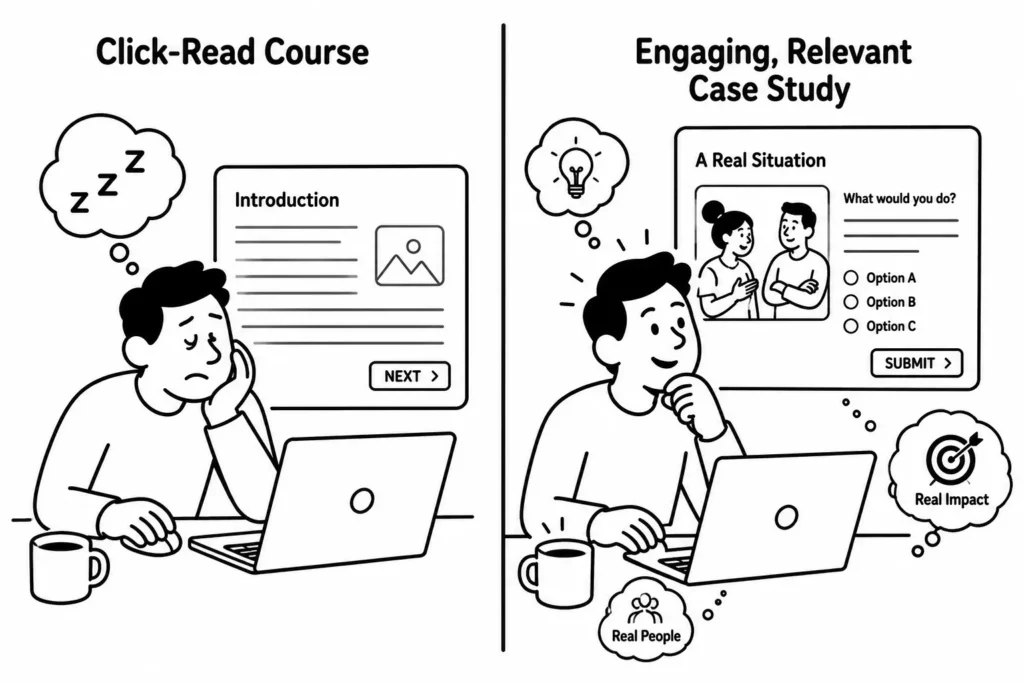
I still remember most of the details of those cases. However, I don’t remember much from any of the click-and-read compliance training I’ve sat through at the same place..
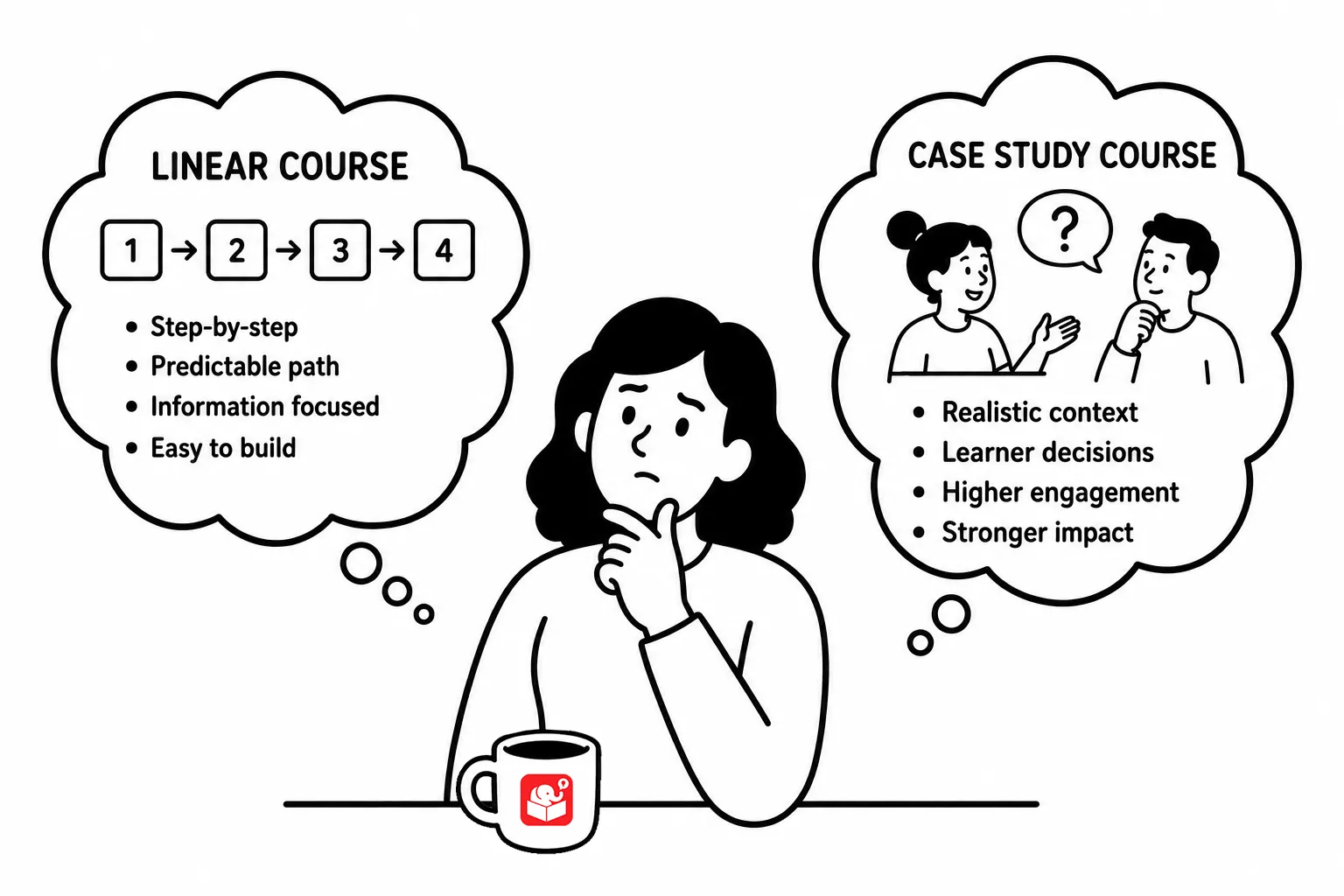
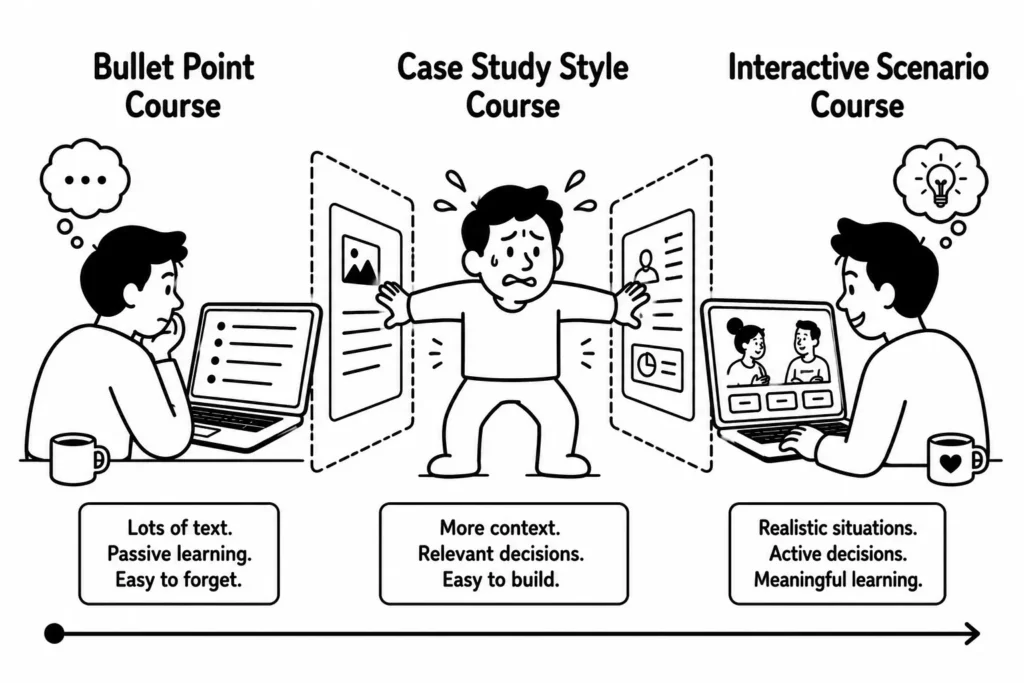
That’s the point. A well-told story in the right context creates a connection that a bullet point course screen can’t. You don’t always have time to build a fully interactive course. But the alternative doesn’t have to be an information dump either. A case study gives you a viable middle path.
A lot of e-learning is linear click-and-read content. That format works for sharing information, but it rarely creates anything that sticks. The most common question I get from course designers is how to make their courses more engaging.
The first rule: make it relevant to the person taking it. If the content has no connection to the learner’s actual work, no amount of interactivity fixes that. Gamification and branched scenarios can feel just as frustrating when the content underneath doesn’t matter to the learner.
Relevance comes before design. Get that right first.
One reason so many e-learning courses look like electronic documents is time. It’s faster to pull information together and publish it than to design something interactive. Most course designers don’t have unlimited time or resources so they defalt to what’s easiest.
Case studies live in a useful middle space. They’re mostly linear, so they’re not hard to build. But they’re framed around a story, so they don’t feel like an information dump.
The learner follows a situation, sees how decisions played out, and understands the stakes. That structure alone creates engagement without requiring complex branching or a fully interactive build.
The good thing is that with AI and some good prompting you can quickly convert a lot of your content to viable case studies.
A few approaches that work well:
Getting good at finding the story inside your content is a skill worth developing. Framing decisions around what the learner actually faces makes any course more effective. Once you’ve built a case study version, you have a foundation to add interactivity later when time allows. What’s one course you’re building right now that could become a case study instead of a content dump?