Physical Address
304 North Cardinal St.
Dorchester Center, MA 02124
Physical Address
304 North Cardinal St.
Dorchester Center, MA 02124
Helpful ideas. Squeaky value.
Helpful ideas. Squeaky value.

Between the workshops I run, the emails I get, and time spent in the e-learning community, I see hundreds of e-learning courses. There’s a common issue that keeps popping up: courses are designed well to share content, but they don’t help people use that content to make the right decisions.
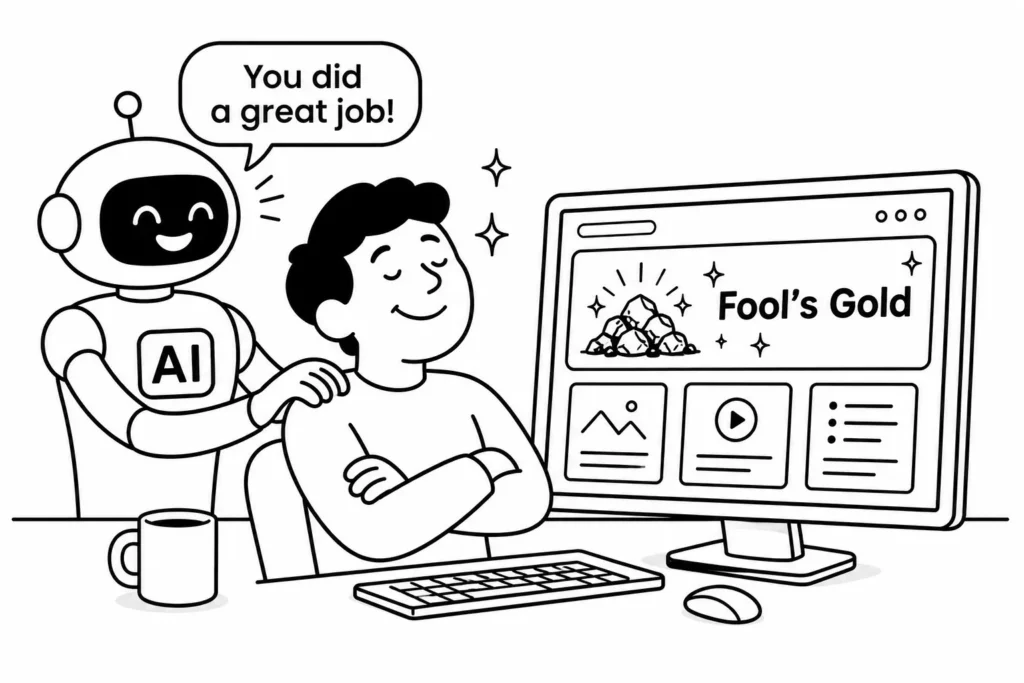
This is probably more a problem now with artificial intelligence as the AI tools are great at converting all of your content from various sources into something that has the appearance of value. It looks like a course with lots of good stuff. But it’s the fool’s gold of e-learning, especially for those just getting started who may not know better.
Stepping away from this issue, many course developers focus on making content interactive, and that’s a good start. But a lot of that interactivity is either novel or pretty basic. What’s missing is the harder stuff: decision-making interactivity. The crafting of a true learning experience.
The real challenge is moving past rote facts. You want learners to practice making the kinds of decisions they’d face in the real world.
A learner clicks through slides, reads information, answers a few basic questions, and gets a completion certificate. The course covered everything, all of the content. But nobody practiced anything real.
Annual compliance training is a different beast. For peformance-based training, this is the biggest issue because content consumed needs to become content applied.
It’s the only way to prove understanding. And ultimately, the only way to prove your worth and that what you build and offer the organization is effective.
Most course developers know that interactivity matters. Adding tabs, accordions, and drag-and-drop activities is a step in the right direction. And those types of interactions are effective in chunking content and concepts and revealing them at a point of need rather than all at once.
What tends to be missing is harder: giving learners a chance to practice decisions they’d make on the job.
Basic interactivity keeps learners moving through content. It creates novelty and reduces the click-through-slides experience. But it doesn’t ask learners to think, weigh options, or deal with the consequences of a choice.
The piece most courses are missing is decision-making practice. The chance to ask: what happens if I do this? What if I choose the other option?
I was thinking more about this the other day as we were presenting on how to use variables in one of our webinars. Variables allow the learner to do something that can be tracked. And then use that information to provide feedback unique to the learner’s experience. They’re perfect for creating this type of training.
A learner does something that gets tracked. The course uses that information to provide feedback tied to their specific path, not a generic right/wrong response. It delivers a better way to assess how they learner is doing and what they understand.
Building this kind of interactivity follows a pattern. Give learners relevant information and ask them to form a judgment. Then create a way for them to act on that judgment and see what follows.
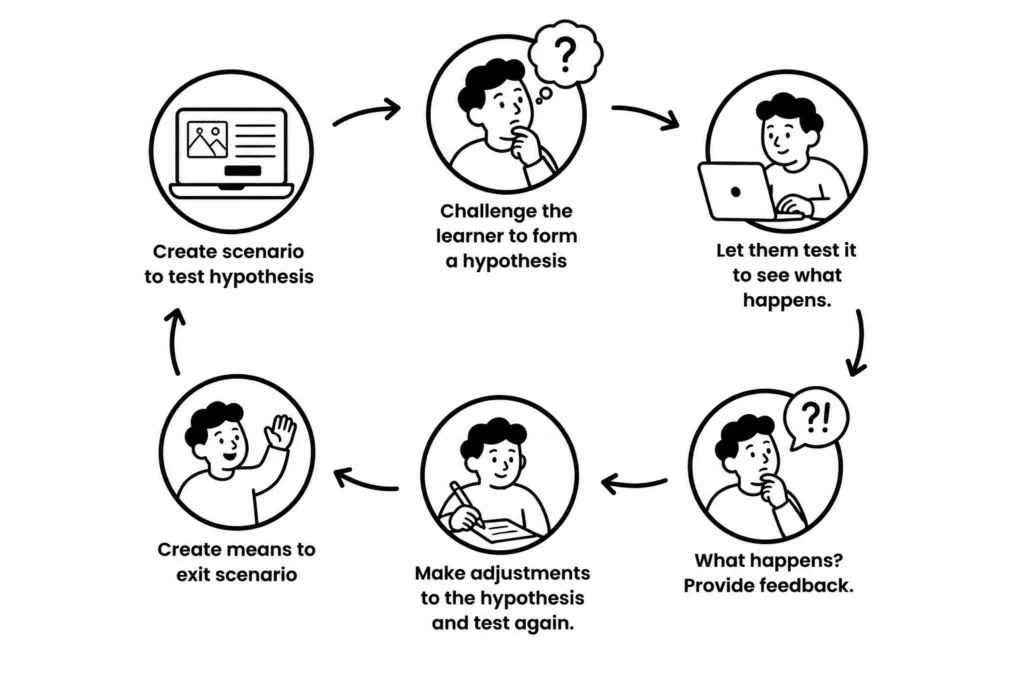
That structure looks like this in practice:
That last step is where the real value is. Giving learners the chance to iterate on a decision is what separates practice from a quiz. That’s why I like the 3C model I designed a few years ago. It’s an easy way to build it and you can keep it simple or compound the parts to create something more complex.
Building decision-making scenarios takes more time. Clients often accept basic click-and-read content without asking for more. When the primary goal is completion tracking, there’s little pressure to add complexity.
There’s also a structural issue. Once a course is locked in an LMS, it stops being a resource learners can return to. A course built around testing ideas is a different kind of tool. Not every organization thinks of it that way yet.
None of this is a reason to avoid the approach. It’s worth knowing which constraint you’re actually dealing with so you can push back on it selectively.
The good thing today is that while AI can create the appearance of value, it can also help convert your content into effective decision-making scenarios.
“What if” scenarios don’t fit every topic, and they take more effort to build well. But for courses where learners make real decisions on the job, this kind of practice is the whole point. Start with a single module where the stakes are highest. Build one “what if” loop and see how learners respond.