Physical Address
304 North Cardinal St.
Dorchester Center, MA 02124
Physical Address
304 North Cardinal St.
Dorchester Center, MA 02124
Helpful ideas. Squeaky value.
Helpful ideas. Squeaky value.
Think about the last time you really needed to figure something out — a problem at work, something that went wrong, a situation you hadn’t seen before. You probably didn’t start by reading the manual. You started by trying to understand the situation. And then from there figure what you need to do.
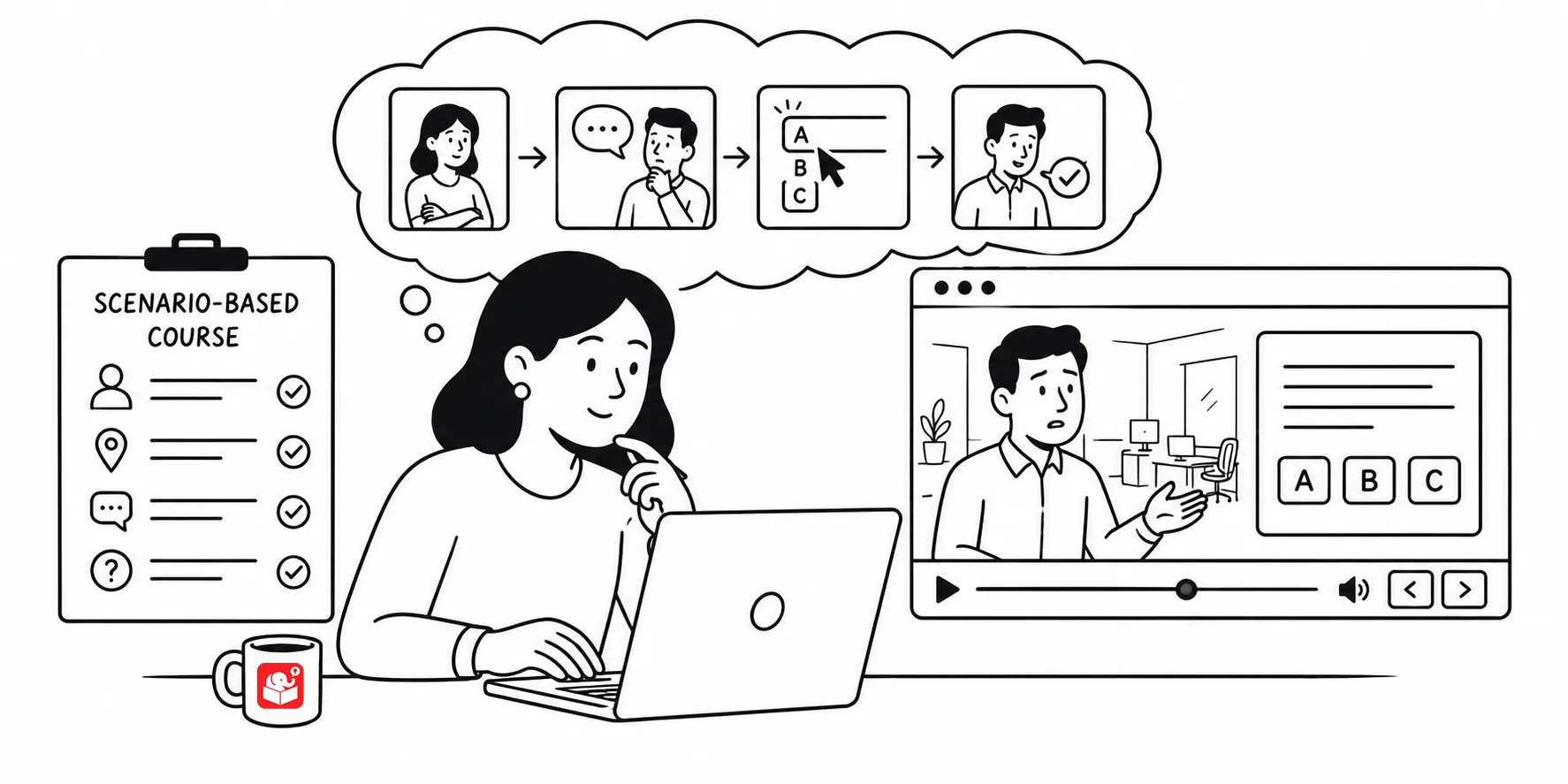
That’s the fundamental logic behind scenario-based learning. Instead of presenting information and hoping it sticks (like most e-learning courses), you put learners in a situation where they need that information to make a decision. It’s the decision-making the drives consuming content.
Linear e-learning does a lot of explaining, but the person is passive and doesn’t do anything with the content. With a decision-making activity where they don’t know, they need to explore, discover, and consume.
Most courses are mostly linear and start with content. Scenarios start with situations.
Before you write a single screen, make a list of the real-world moments where a learner would need to use what you’re teaching. Not sure what those are, ask the subject matter expert and the people who will take the course.
Let’s look at an example of workplace injuries. You could list a bunch of policies and whatnot as your course content. Then add a quiz. That’s what’s most common. Or you could have a manager notice that someone is limping and start to investigate why. Did it happen at work? What does the manager need to do?
Starting with a situation instead of content changes what your course is about. The course becomes a place to practice handling that situation rather than a place to absorb information about it.
Most scenarios are ineffective for two reasons. The first is that the course content and objective doesn’t warrant a scenario. The course designer wants to make the course interactive, but then they overbuild it and make it a waste of time as people need to go through a scenario rather than read 5 bullet points.
The other is that the choices aren’t the best. Often, there’s one obvious good choice and then the rest or either too simple, or a bit stupid. One clearly correct answer and two absurd wrong ones. Learners recognize that pattern immediately and stop thinking.
In the past it was always a challenge to write good scenarios because of the SME not working with you or the process was too complicated. With AI, that has changed and with good prompting, you can get really good choices and feedback.
Real situations have multiple reasonable options. Your scenarios should too. Work with your subject matter experts to find the genuine judgment calls: the decisions people get wrong not because they didn’t know the rule, but because they misread the situation or weighted the factors incorrectly.
For the workplace injury scenario: one learner might immediately notify senior leadership, another might ignore it if it doesn’t seem serious, another might contact HR. Each of those could be reasonable depending on circumstances. That ambiguity is what makes a scenario worth working through.
This is where most of the actual learning happens. Don’t just tell the learner they were right or wrong — show them what their choice produced.
If a learner chose to review the policies, continue the story: they contact senior leadership, maybe they get scolded or ignored. Now what? That branching consequence gives the learner information they can actually use. It mirrors how real situations unfold, where every decision creates a new situation with its own constraints.
Feedback through consequences is more memorable than feedback through result screens. “That’s not the best choice” teaches nothing. Seeing the situation deteriorate because of a decision teaches something specific.
The most important quality a scenario can have is authenticity. If the situation doesn’t feel like something that would actually happen, learners will treat it like a game instead of practice.
Run your scenarios by subject matter experts before launch. Have a few actual learners work through them. Listen for comments like “that would never happen” or “nobody would actually choose that option.” Those are signals that the scenario needs work. Your goal is for learners to finish and think: that felt like something I’m actually going to face.
Want to learn more about interactive scenarios, check out the posts on the 3C model and the others on scenarios.