Physical Address
304 North Cardinal St.
Dorchester Center, MA 02124
Physical Address
304 North Cardinal St.
Dorchester Center, MA 02124
Helpful ideas. Squeaky value.
Helpful ideas. Squeaky value.
At a conference, I was talking to someone about e-learning strategies. My starting point is always to begin with what’s easiest and build from there. It keeps production fast and lets you put resources where they actually matter.
Part of that conversation came back to an idea that keeps coming up: the tendency to treat the course as an event rather than part of the p[rocess.
When we equate training with learning, we build courses. When we build courses, we create a single event and then move on. The course catalog fills up, but the learning is confined to the course itself.
How often do you get reinforcement after finishing an e-learning module? In most organizations, the answer is rarely or never.
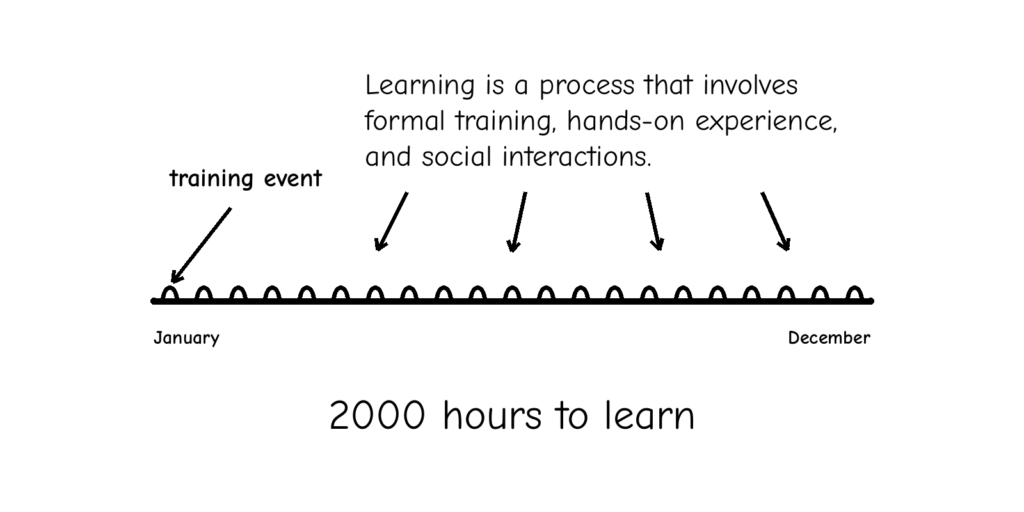
A typical work year is around 2000 hours. During those 2000 hours, people learn. Not because we gave them a course, but because learning is always happening. They’re getting information from managers, peers, customers, and their own daily work. There’s no off switch.
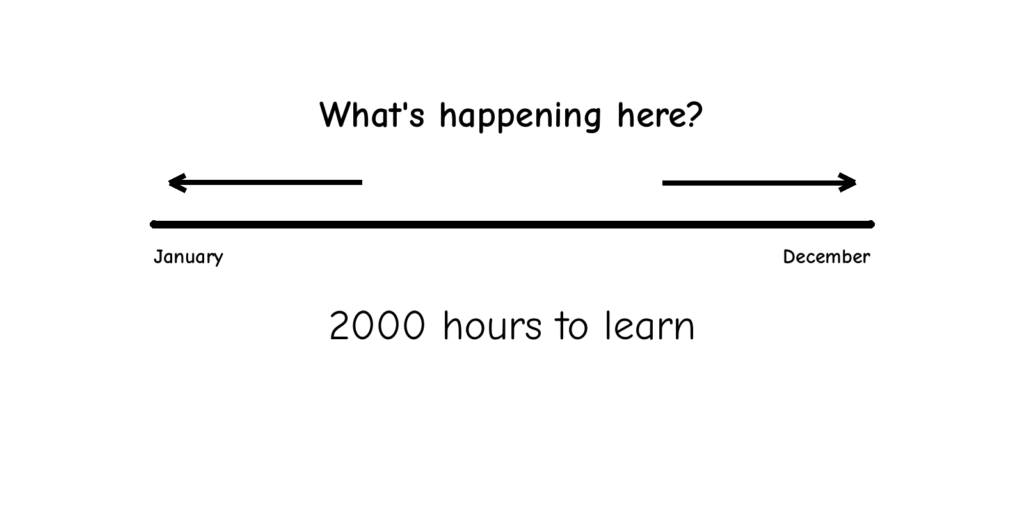
So the question isn’t whether learning happens during a work year. It always does. The question is how much of those 2000 hours your training program actually connects to.
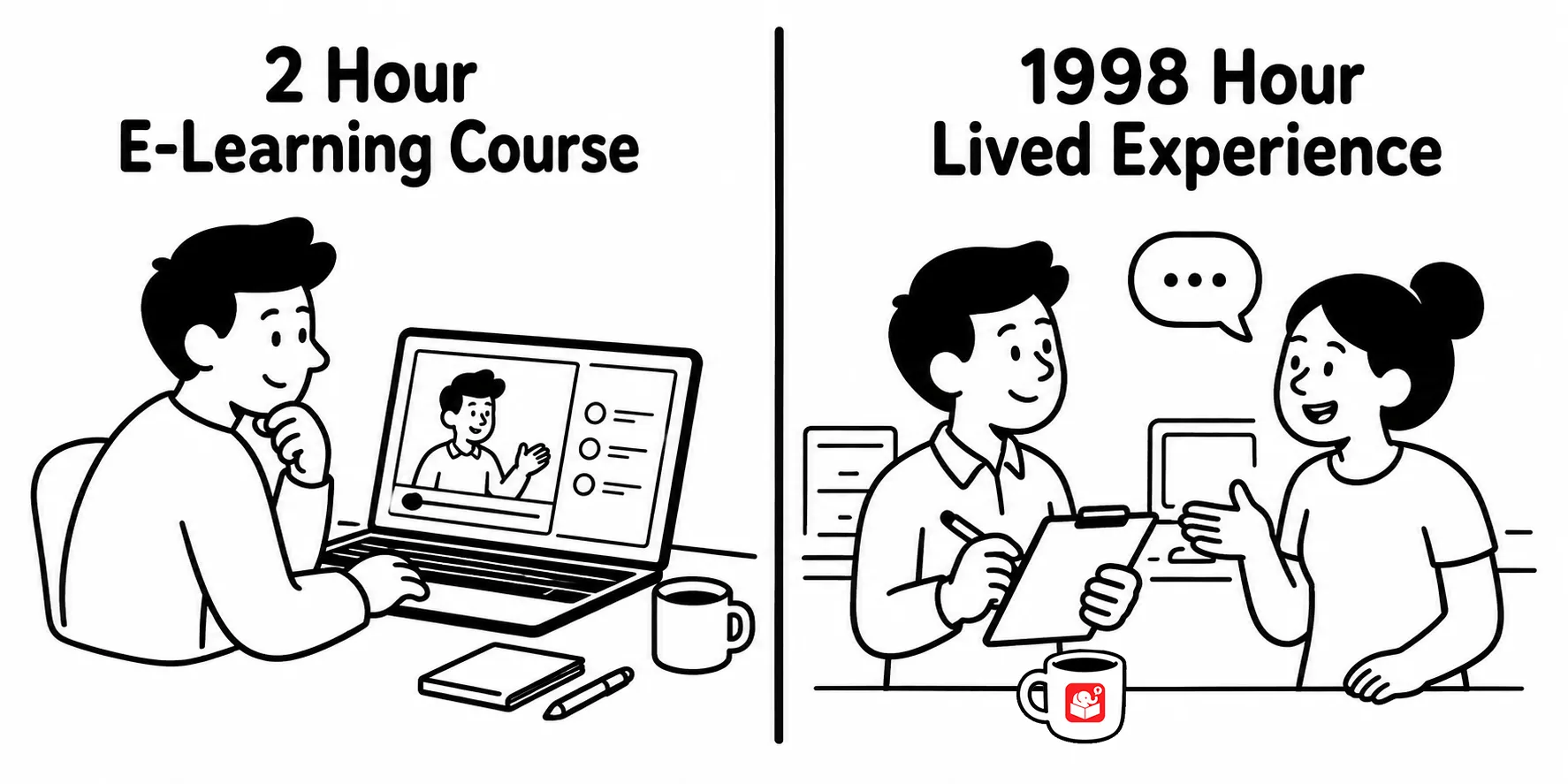
If you run a well-designed two-hour e-learning course, you’ve touched two hours out of 2000. Without reinforcement or follow-up, those two hours have to do all the heavy lifting. A lot of the value disappears quickly once the course window closes.
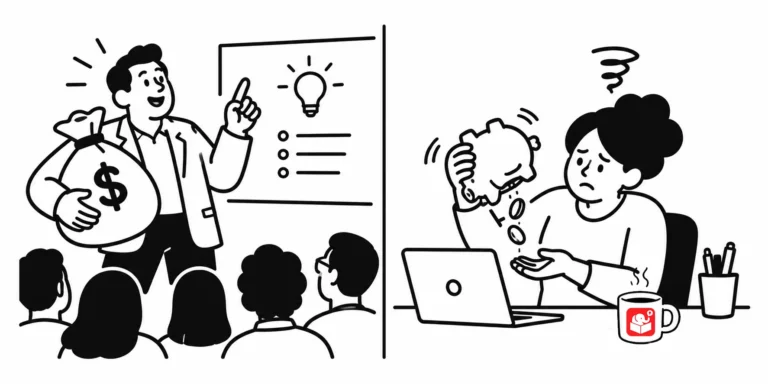
Custom e-learning development is expensive. A few years back, research from Bryan Chapman puts the costs roughly at $35,000 for third-party courseware, $22,000 for standard e-learning, and $3,300 for in-house e-learning. These figures are ballpark figures and every project is different, but the proportional difference is real.
The bigger issue is where the money goes. In most e-learning projects, roughly 90% of the budget gets spent on building and implementing the course. That leaves almost nothing for post-course reinforcement or follow-up, the things that would actually extend learning beyond the event.
E-learning like you get with Articulate changes the math. Because production is faster and less expensive, you can afford to build smaller, targeted interventions and distribute them throughout the learning process.
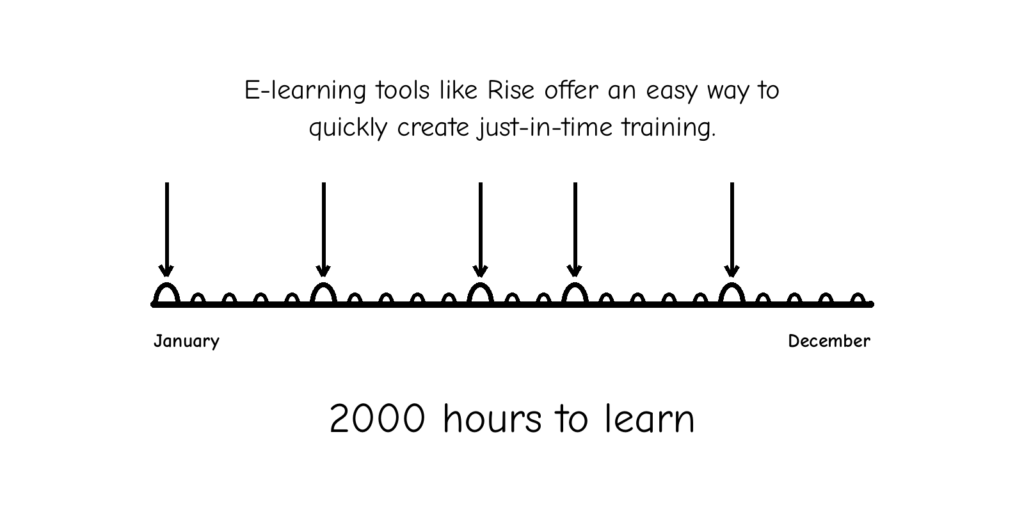
Instead of one big course, you can build a few milestone courses and fill the space between them with short reinforcement pieces.
I built a course once where we followed up with scenario emails sent at scheduled intervals after the formal training. Learners worked through the scenarios and discussed their answers with their managers. Managers reviewed responses and sent feedback to close the loop.
This worked well for a few reasons.
That kind of approach isn’t practical when you’re dependent on specialized programmers for every update. It works when the production tools are accessible enough that small follow-up pieces are actually viable.
Look at your current training catalog and identify one course that would benefit from a reinforcement module delivered two to four weeks after completion. Map out what that would look like. If you can build it quickly, that’s a sign your e-learning tools are working the way they should.