Physical Address
304 North Cardinal St.
Dorchester Center, MA 02124
Physical Address
304 North Cardinal St.
Dorchester Center, MA 02124
Helpful ideas. Squeaky value.
Helpful ideas. Squeaky value.

Think about the last time you tried to learn something genuinely new. Maybe it was a software tool or a process you’d never seen before. At some point it probably felt like your brain just hit a wall. That’s not a character flaw. That’s cognitive load.
Cognitive load is the mental effort your learners use while working through your course. Every piece of information they see, every decision they make, every new term they encounter draws from the same limited pool. When that pool runs dry, nothing gets retained.
Your learners have two kinds of memory doing work during a course. Long-term memory is where all their existing knowledge lives. Working memory is where active thinking happens, and it’s tiny.
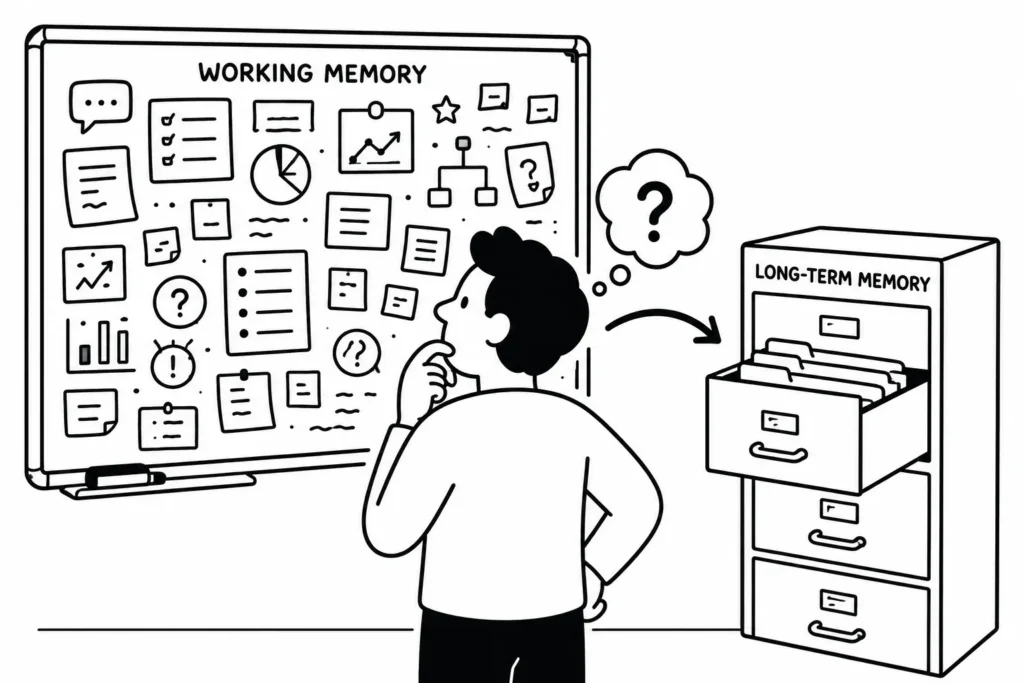
Think of working memory like a small whiteboard. You can write on it, erase it, and work through problems. But it only fits so much. Once it’s full, new information has nowhere to go. And anything that doesn’t make it off the whiteboard gets lost.
That’s the design problem. Most courses pour information onto the whiteboard faster than learners can process it. The result isn’t learning. It’s an overwhelmed learner.
Here’s something worth knowing before you start cutting content. There are two kinds of mental effort in a course, and they’re not the same thing.
The first is effort that comes from the subject itself. Some topics are just harder than others. Teaching someone basic safety rules is simpler than teaching someone to read a financial report. That complexity is real, and you can’t eliminate it.
The second is effort caused by your design. Cluttered slides, confusing navigation, narration that reads every word on the screen, irrelevant images, no clear structure. That kind of effort is optional. It doesn’t help the learner understand anything. It just makes the course harder than it needs to be.
Your job as a course designer is to protect working memory for the first kind of effort. The second kind is on you to fix.
I’ve seen courses that were genuinely short on content but still felt exhausting. Not because the topic was hard, but because the design made every screen a puzzle. Dense slides, unclear instructions, audio that contradicted the text. The learner spent all their working memory just figuring out the course, with nothing left over for the actual learning.
Flip that around. A well-designed course on a complex topic can feel manageable if the design is clean. Clear structure, simple screens, relevant visuals. The difficulty is appropriate because it comes from the subject, not the layout.
That’s the thing cognitive load theory is actually trying to tell you. Don’t make it harder than it has to be.
Before you build your next course, ask yourself one question: where is the effort coming from? If the answer is the subject matter, that’s expected. If the answer is the design itself, that’s a signal. In the next post, we’ll look at specific things you can do to reduce unnecessary mental effort and make your courses easier to work through.