Physical Address
304 North Cardinal St.
Dorchester Center, MA 02124
Physical Address
304 North Cardinal St.
Dorchester Center, MA 02124
Helpful ideas. Squeaky value.
Helpful ideas. Squeaky value.
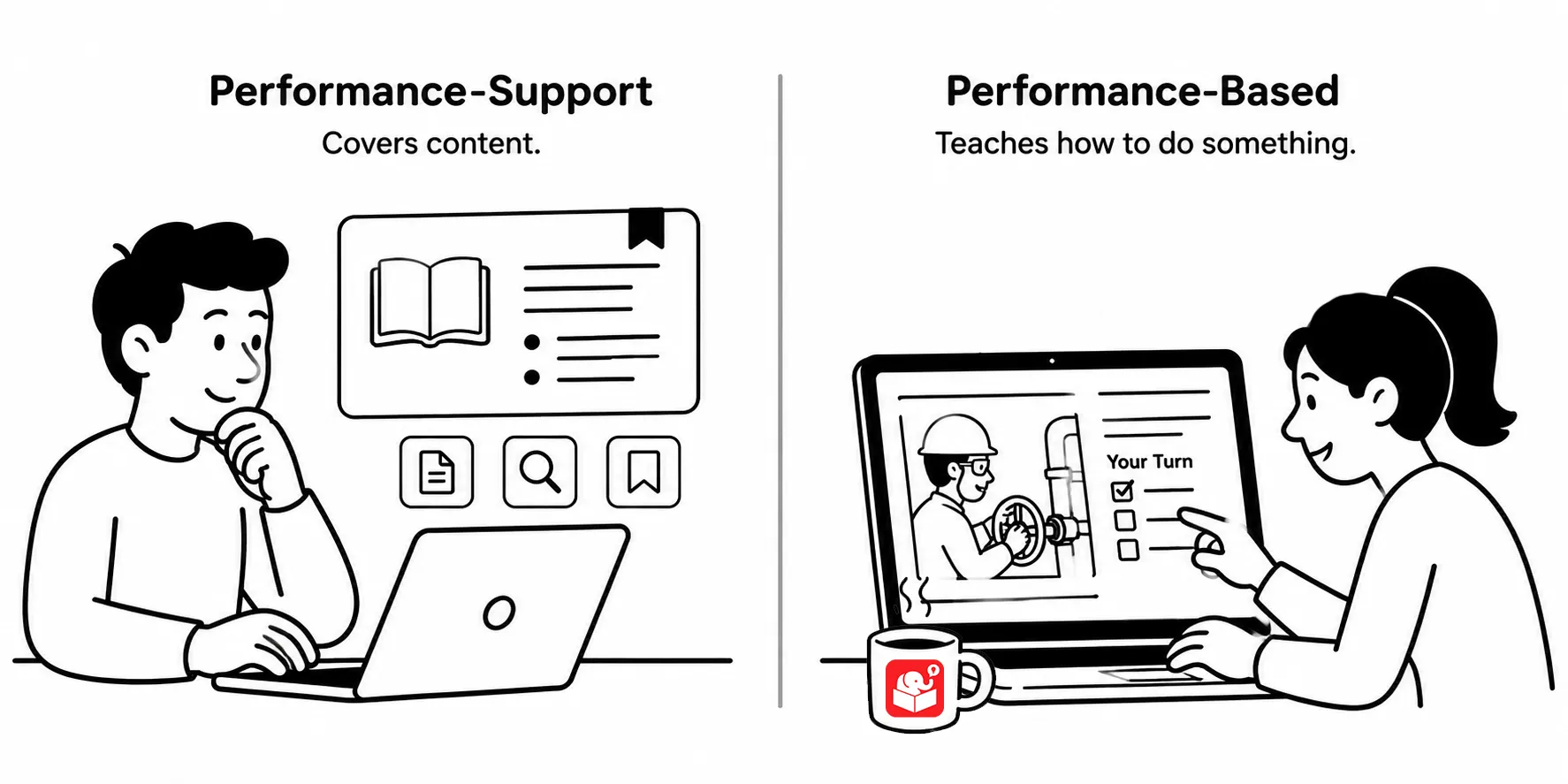
We have a definition problem. Not everything we call “e-learning” is actually about learning. And definitely not about performance improvement.
Modenr e-learning tools let us build interactive multimedia content. That content may or may not have anything to do with learning. The way I see it they’re not much more than interactive online documents moreso than e-learning.
Take some of the courses I’ve built over the years. Plenty of them were more about concepts and information. Important information, sure, but not tied to any immediate or specific performance expectation. What I built was closer to a multimedia ebook than a course meant to train someone to do something.
Other courses I’ve built had real performance requirements. Those meant building real-world scenarios where the learners made the same kind of decisions they faced on the job.
We called both of these e-learning. But they weren’t the same thing at all. One was more like e-marketing, or e-information if you want to get technical. The other was e-performance.
My fix? Sort every course or piece of multimedia content into one of two buckets. Either it supports performance, or it exists to change performance.
Performance support courses are mostly about sharing information. They could be online job aids, overviews of policies, and additional resources. The goal isn’t to change behavior. It’s to make sure someone has access to what they need when they need it.
Say the organization has an online training program for new managers on the bonus plan.
A performance support course walks through the specifics of the plan. It doesn’t ask the learner to do much beyond taking in the information. There might be a quiz at the end, but that’s just testing general knowledge. It’s not measuring real understanding. And that’s fine, because this kind of course is about sharing information, not changing performance.
Three questions cover most of it:
If you can say yes to all three, the course is doing its job.
Performance-based courses have a different job. They’re designed to change what people do, and that requires a different kind of design.
Instead of walking through information, these courses ask learners to face realistic situations and make decisions. A scenario where a manager decides who qualifies for a bonus teaches more than a page of about bonus policies and details.
For a performance course to work, three things need to be true:
The only real measure here is whether behavior changed. If the goal was to improve sales, the course needs to contribute to measurable sales growth. A well-designed scenario maps directly to real-world performance. Measure the actual behavior, not just quiz scores.
The two-bucket framework makes a practical difference right from the start. Before you build anything, decide whether your goal is to inform or to change behavior. That single question shapes your design choices, your scenario work, and what you’ll use to measure success.