Physical Address
304 North Cardinal St.
Dorchester Center, MA 02124
Physical Address
304 North Cardinal St.
Dorchester Center, MA 02124
Helpful ideas. Squeaky value.
Helpful ideas. Squeaky value.
A few years ago I was working late when the fire alarm went off. Everyone knew the evacuation procedure because we’d all taken and passed the annual safety training. We gathered our belongings (not part of the training) and walked to the nearest exit just as instructed (or so we thought).
There were two sliding doors. We made it through the first one and the second one never opened. The first door closed and we were stuck between two glass doors, exposed to a potential fire like rotisserie chickens at Costco. We were stuck and didn’t have any idea how to get out.
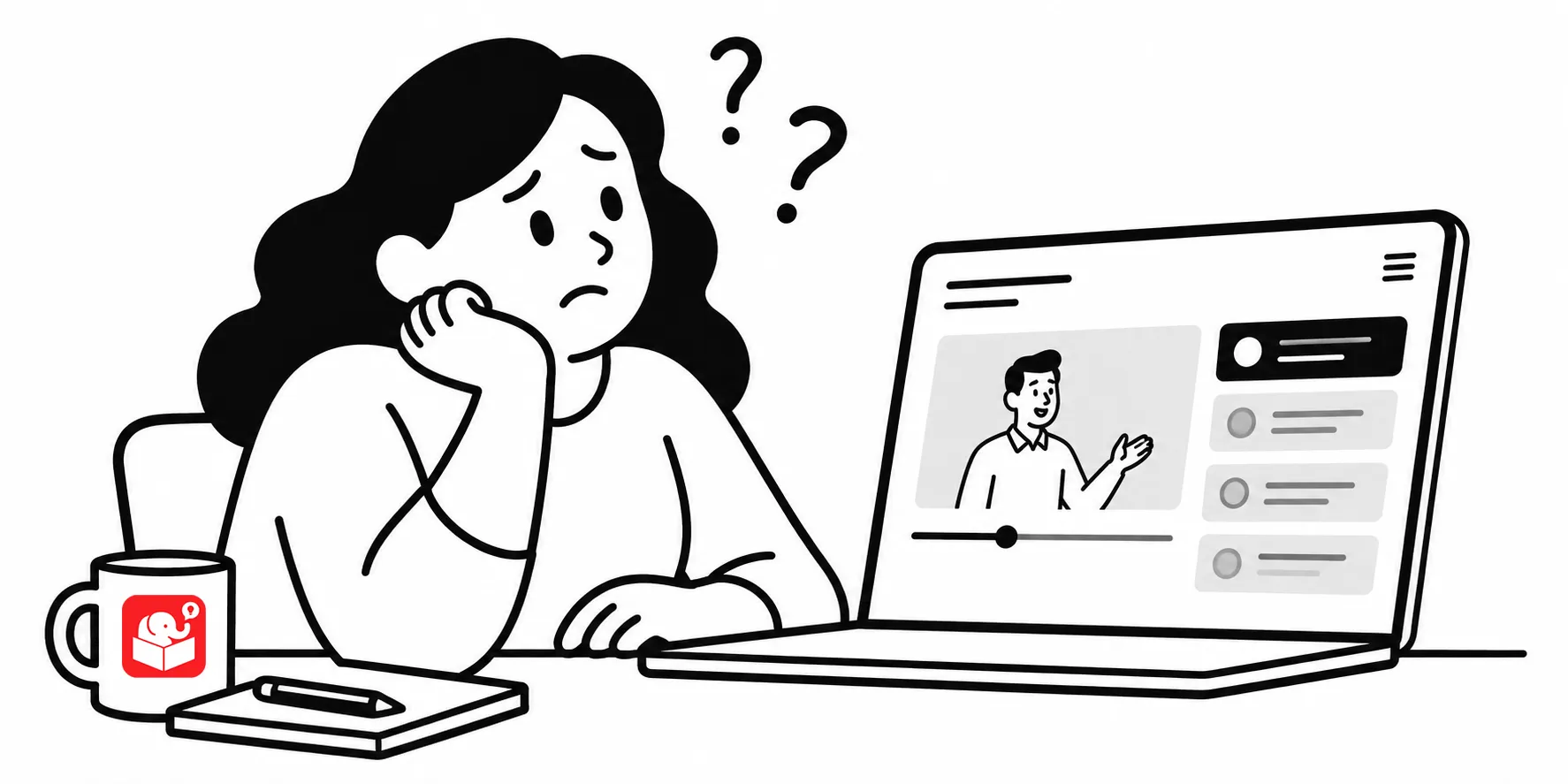
The safety course had given us information. So we had knowledge about what to do. But it never really prepared us for what actually would happen. We didn’t know what do even though we kind of had the know-how.
This is not uncommon for most e-learning that focuses on sharing information but are a bit weak in building true actionable understanding.
Here are five ways to close that gap.
This sounds obvious, but a lot of courses skip it. If you don’t define exactly what learners should be able to do differently after the course, you end up building a container for content rather than a proper learning experience.
Clear objectives aren’t just bullet point lists at the front of the course. They’re the filter that determines what goes in the course and what doesn’t. Every section, every activity, every question should point back to a specific outcome.
A quiz measures recall. That’s fine for a lot of courses. A decision-making scenario measures judgment. If your objective is for learners to make better decisions in real situations, you need evidence of that, not just evidence that they read the content.
Think through what a learner who truly understands the content would be able to do. Then build your assessments to capture that. Multiple choice at the end of each section often doesn’t cut it.
The gap between knowing and doing usually comes down to context. Learners can absorb facts in isolation, but applying them under realistic conditions is a different skill.
Put learners in situations where they have to use the information, not just receive it.
Interactive scenarios with real-world decision points work toward this. Even a well-constructed case study can create more understanding than several slides of explanation.
People don’t automatically connect new information to what they already know. They need a nudge. Ask questions that make them think about the content in relation to their own experience.
Case studies, thought questions, and simple journaling prompts all encourage reflection. The goal is to make the learner actively process the information rather than passively absorb it.
Controlled exploration is one of the most underused tools in e-learning. When learners can make choices, take different paths, and see the consequences of their decisions, they build understanding that a linear presentation can’t match.
This doesn’t have to be complicated. Freeing up navigation so learners can explore a concept from different angles is a start. Branching scenarios that let them experience realistic consequences of different choices are even more effective.
Start with reflection. It’s the easiest one to add and often the most neglected. Build one or two thought-provoking questions into your next course that ask learners to connect the content to their own work.
Once that’s a habit, layer in a scenarios or other prove-it activities. The courses you build after that will be noticeably different from the ones you built before.