Physical Address
304 North Cardinal St.
Dorchester Center, MA 02124
Physical Address
304 North Cardinal St.
Dorchester Center, MA 02124
Helpful ideas. Squeaky value.
Helpful ideas. Squeaky value.
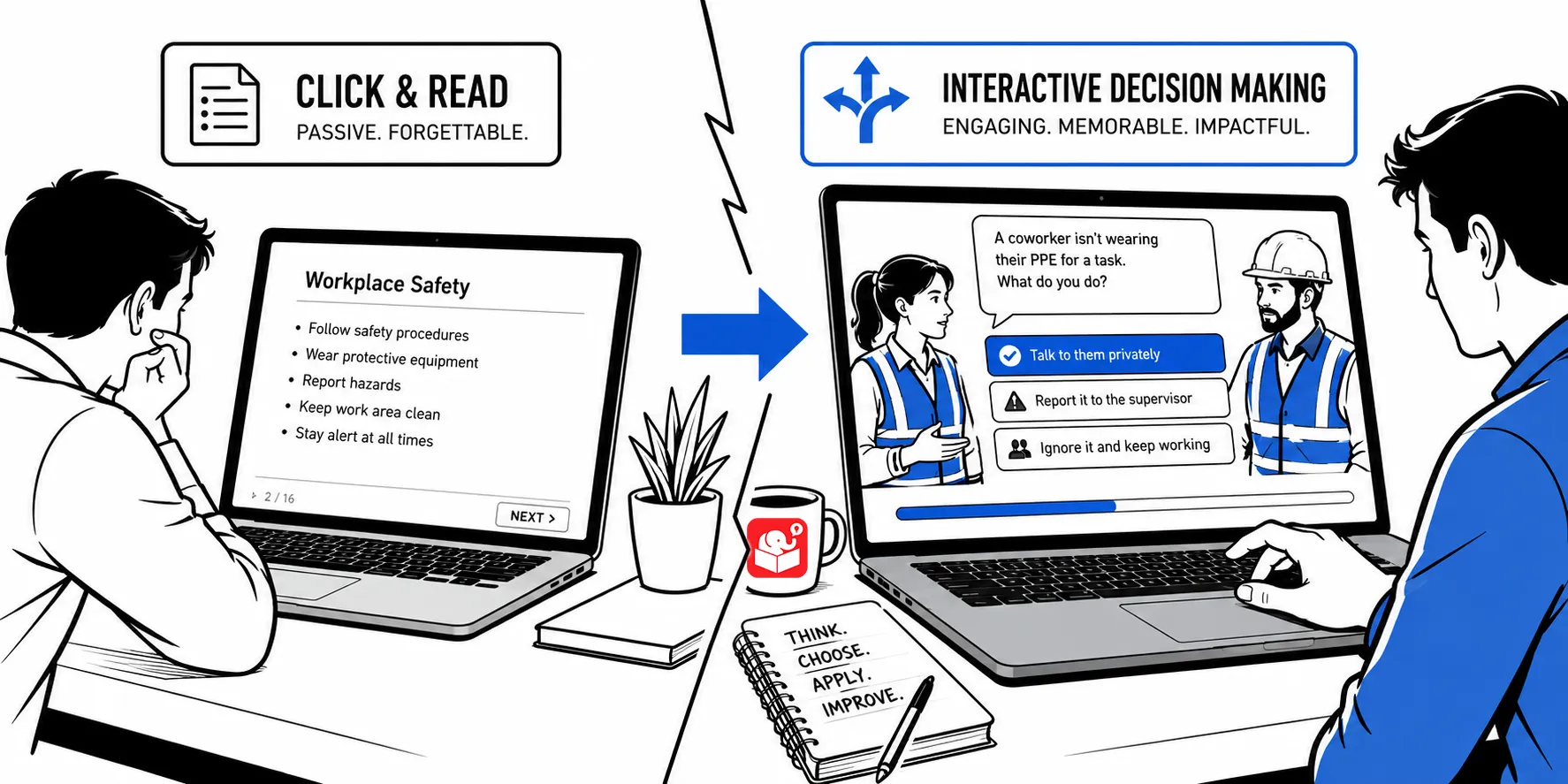
About 30 years ago, I was working with subject matter experts and new instructional designers. I found the same problems over and over again. Either they were building linear, click-and-read courses when the content really called for performance-based practice. Or things got complicated because they were so deep in branching diagrams and scenario logic that nothing ever got built.
So I said: stop. Let’s focus on the types of decisions a person needs to make using this content in the real world. What we need to do is work with their current level of understanding and challenge them to make decisions.
This is not a quiz. The idea is to use their current level of understanding to make decisions and from there they’ll get feedback and the content they need to learn.
That thinking became the 3C model. It’s been my go-to structure ever since.
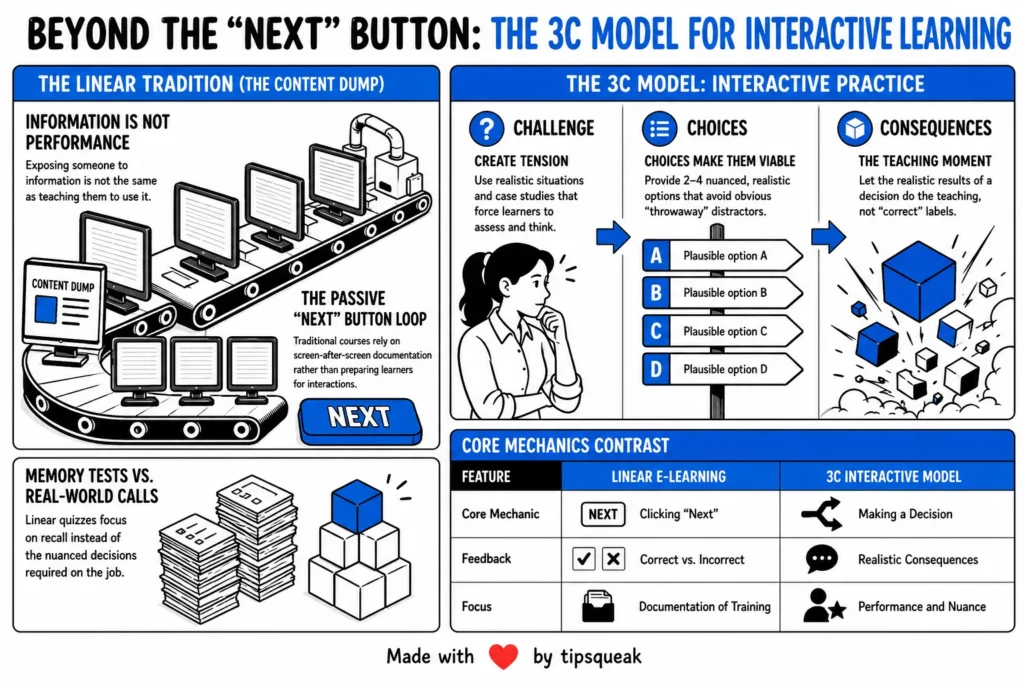
I see hundreds of courses every year. I can tell you that not much has changed in 30 years and most courses are still content dumps. Screen after screen of information, a next button, and a quiz at the end. The technology has gotten better over the years. The problem hasn’t.
Exposing someone to information isn’t the same as teaching them to use it. In the real world, people interact with other people and make decisions. Those decisions have consequences. A course that just presents information doesn’t prepare anyone for that. It just documents that training happened.
The fix isn’t complicated. You don’t need a 40-slide branching scenario. You need to put the learner in a situation, give them a decision to make, and let the consequence do the teaching.
The model has three parts: Challenge, Choices, and Consequences. That’s it. Each 3C is a single building block. Use one and you have a simple scenario. Stack a few and you have a branched interaction. The structure stays the same either way.
Think of it like a Lego brick. The brick doesn’t change. The complexity comes from how many you use and how you connect them.
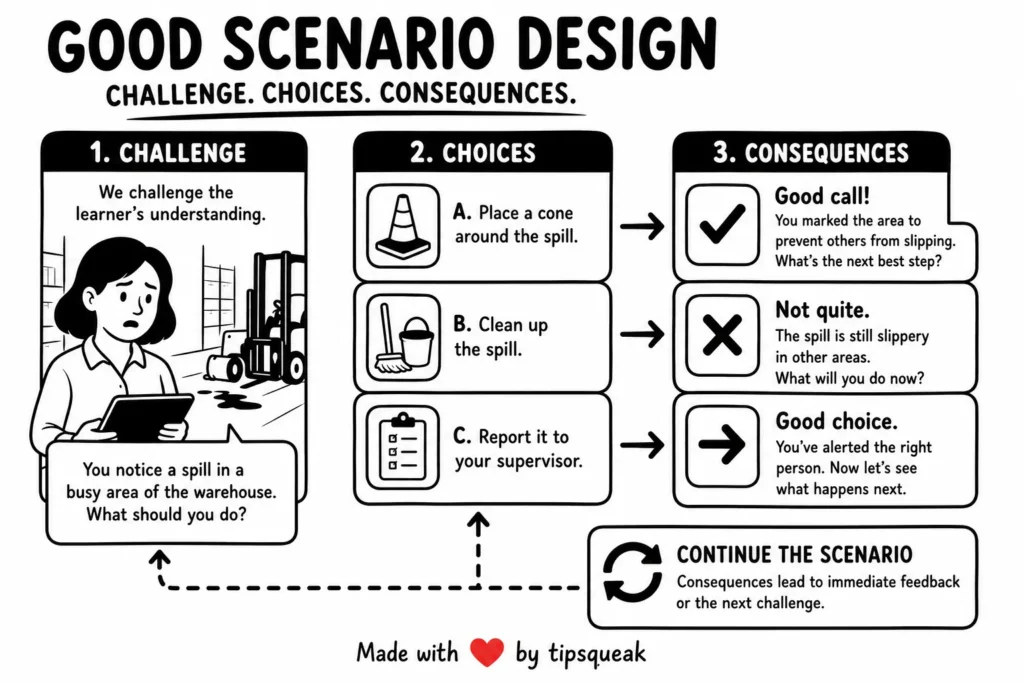
The challenge gets the learner to think. It can be a simple question or a short case study. What matters is that it puts the learner in a realistic situation connected to the actual job.
Don’t make it a memory test. The goal is to create a little tension. The learner has to assess something and make a call. That tension is what drives engagement. It’s also what makes the feedback land when it comes.
Once the learner is challenged, they need to make a decision. Most courses aren’t open-ended where any type of challenge and choices can be created dynamically, on the fly. Although this may change with AI. They still need to be built with choices that are hard coded. This is where most scenarios fall apart.
The choices have to be viable. If one option is obviously correct and the others are throwaway distractors, there’s nothing to think about. The learner just spots the answer and clicks through. Nuanced choices force real thinking. Stick to two to four options. More than that and the branching becomes hard to manage and harder to write well.
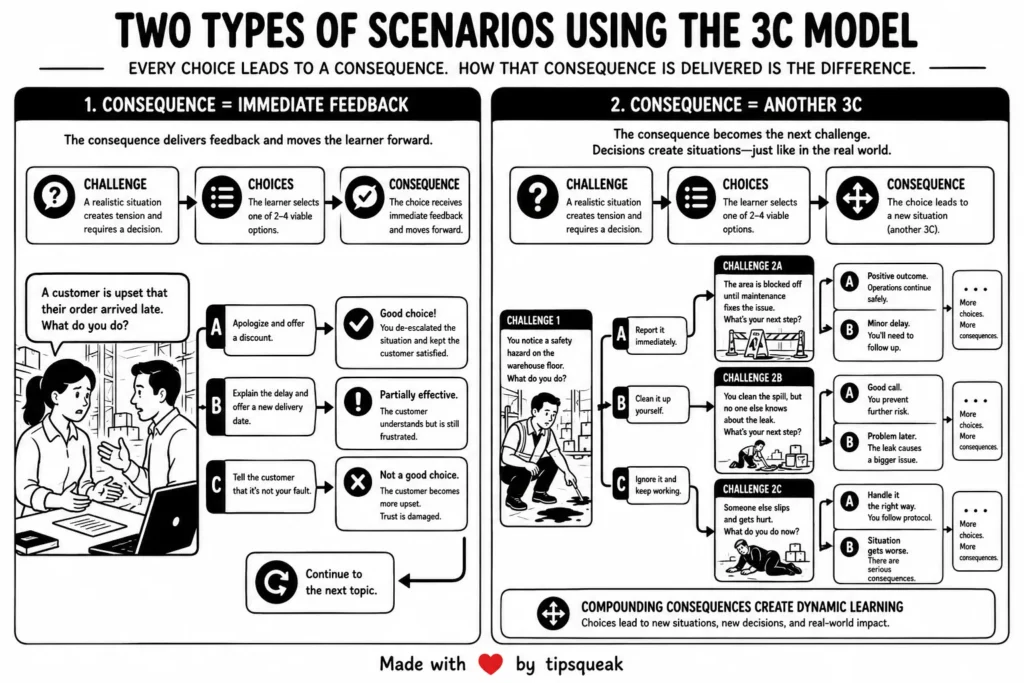
Every choice produces a consequence. This is where the learning happens. But it doesn’t have to be a “correct” or “incorrect” label.
You have two options here:
The second approach is more true to how the real world works. Decisions produce situations, not verdicts. Compounding consequences creates a much more dynamic learning experience. And it mirrors what actually happens on the job.
The fastest way to get started is to pre-build your templates before you have any real content. Build generic 3C structures with placeholder content in two-choice, three-choice, and four-choice versions. When you’re ready to build a course, drop in a template and swap the placeholder content for the real thing. Of course you can forgo using templates and build everything from scratch, but that’s not the most efficient thing to do.
Here are a few things that help:
The biggest misuse of the 3C model is building scenarios for the sake of looking interactive. If you can explain what the learner would get in one sentence, skip the scenario and write the sentence. Sometimes five quick bullet points is worth more than a five minute interactive scenario.
A few other things worth watching:
Pick one course you’re working on right now where the content is performance-based. Map out one decision a learner needs to make on the job. Build a single 3C around that decision. That’s your starting point. Once you have one working, adding more is easy. The model scales as far as the content requires.