Physical Address
304 North Cardinal St.
Dorchester Center, MA 02124
Physical Address
304 North Cardinal St.
Dorchester Center, MA 02124
Helpful ideas. Squeaky value.
Helpful ideas. Squeaky value.

A course can look great and include great content, but that doesn’t mean it’s a course the learner is interested in. I’ve seen really well designed courses (at least on the surface) fail to engage people.
The problem usually isn’t the material, it’s motivation. Here’s why that happens, plus five ways to build engagement back in, including where AI helps and where it doesn’t.
Most training doesn’t come with built in stakes. Most of use aren’t designing flight simulators with life or death considerations. Most people’s jobs aren’t on the line if they zone out during a compliance module. That means motivation has to be designed in on purpose. It’s often the not considered and the reason even solid content falls flat. The reality is we build a lot of content and courses oblivious to the learner’s needs.
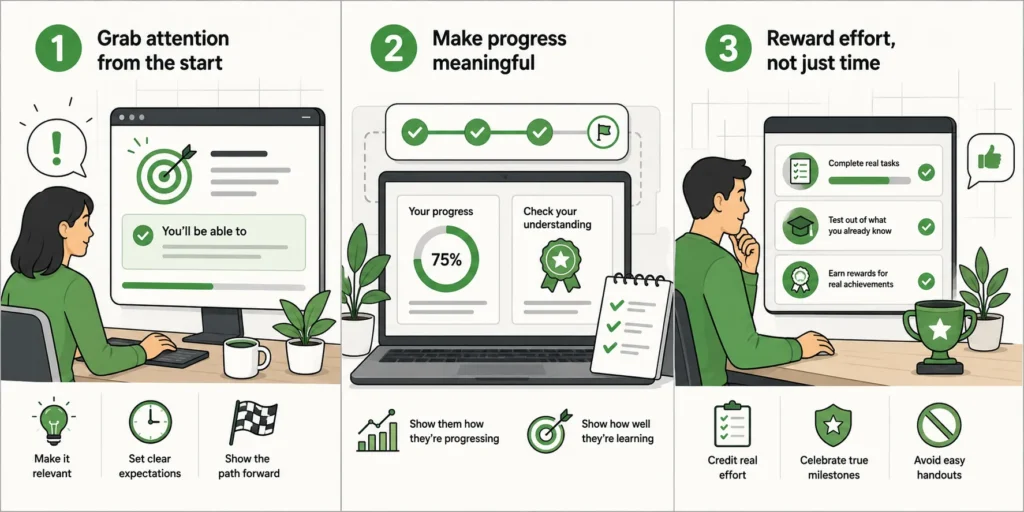
Learners decide fast whether a course is worth their attention. This is especially true in the world of Instagram and TikTok where we’re conditioned to determine quickly if we’re engaged or not.
We need to let people know why the course is important to them. Telling them “this applies to your role” isn’t specific enough to keep them there. Telling them “you’ll be able to close a ticket without escalating it” is. Say the specific version, and say it in the first two minutes.
A progress bar works, but it doesn’t excite anyone. Tie progress to something inside the world of the course instead, and it starts to mean more.
I’d focus on two aspects of progress:
There’s a lot of focus on gamification. Often people well earn things as they progress. Badges and certificates don’t mean much if they’re handed out for time spent instead of work done.
A reward that I think lands well is often letting a learner test out of a course they already know. Here are a few ways to keep rewards tied to real effort:
Confusing navigation burns energy that should go toward learning. Tell learners upfront how long a section takes and what success looks like.
Make the next step obvious so they never have to stop and think about how the course works. Every bit of mental energy spent on the interface is energy they’re not spending on the content.
The most engaged I’ve ever seen a group of learners get had nothing to do with a slide. It came from a stat that contradicted what everyone in the room assumed.
That little jolt of “wait, really?” does more for attention than almost anything else on this list. Use a surprising fact, a common misconception, or a scenario that quietly proves an assumption wrong.
A lot of instructional designers lean on AI now to help write course content. That’s a good thing, within limits.
AI handles the mechanical parts well. It’s good at drafting scenario variations, writing rough wrong answers for a knowledge check, and rewording objectives so they’re clearer. Where it falls short is judgment, because it doesn’t know your learners or which misconception actually trips up your team.
The surprising fact that grabs a room only works if it’s actually surprising to that room. AI written “surprising facts” tend to be generic, because the tool doesn’t know what your specific audience already believes. That gap between generic and specific is where you, the instructional designer, earn your keep. Use AI to draft, then spend the time it saves you on the parts that matter. Those are the parts that need someone who’s actually talked to the learners.
A quick way to split the work:
Pick one tactic from this list and build it into your next course before you try all five at once. Start with the section that feels hardest to sit through right now, since that’s usually where motivation leaks out fastest. If you’re using AI to draft content, spend the saved time talking to learners about what trips them up.