Physical Address
304 North Cardinal St.
Dorchester Center, MA 02124
Physical Address
304 North Cardinal St.
Dorchester Center, MA 02124
Helpful ideas. Squeaky value.
Helpful ideas. Squeaky value.

Note: This post is a rewrite of some thoughts I posted in the Rapid E-Learning Blog way back in 2007. Hard to believe it’s been two decades. In some ways, things have changed. We have better technology. Everyone has access to it. And now we have AI.
With all that said, these are still good basic tips for the person who builds training regardless of the authoring software you use and if you use AI to support this process or not.
A client once called me wanting a course to improve the sales team’s numbers. I asked a few follow-up questions before agreeing to anything. Turned out the real problem was a broken process, not a skill gap. We didn’t create the project, or at least not as she originally intended.
Instead of a big course that would have taken a lot of time, we built a simple explainer type module that only took a few days. And then the client went off to figure out how to fix the broken process.
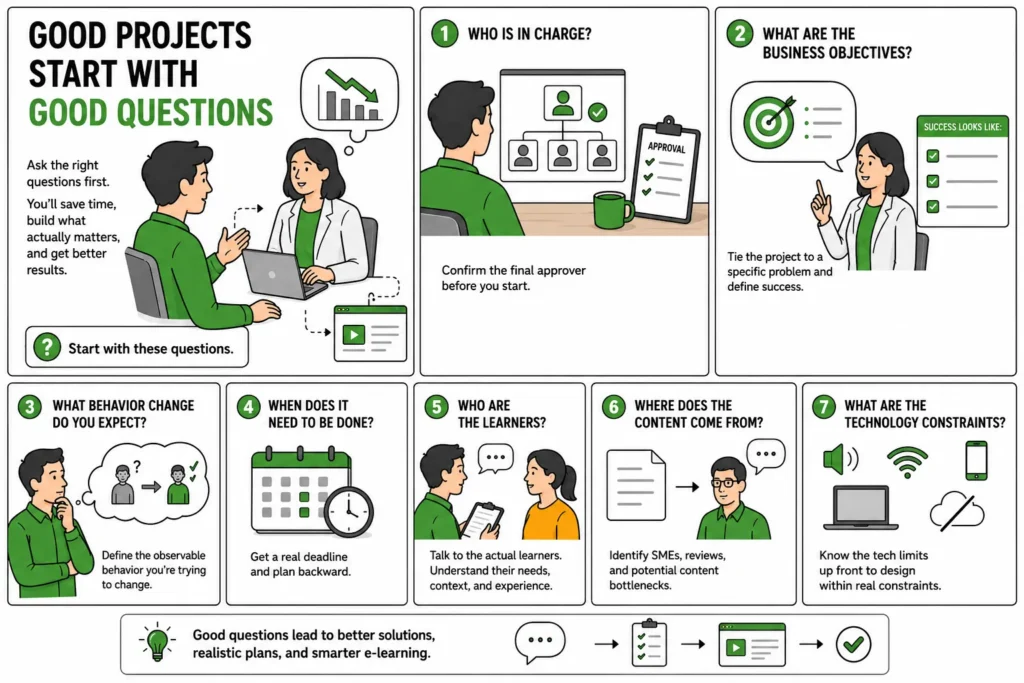
This list below isn’t exhaustive, but it’s a good start focused on the right things.
Find out who has final approval before you start. This seems obvious, but it’s the question most people skip.
The typical result: you build something, somewhere in the process, a new reviewer appears, and you’re suddenly two weeks behind making changes to your course.
Getting clarity on the approval chain early prevents that. Ask directly who signs off before the course goes live, then copy that person on your project plan. Definitely make sure you have their vision and ideas captured before you invest too much time.
This question shifts the conversation away from “build a course” and toward “solve this specific problem.” It also gives you the measurement criteria you’ll need to show the project worked.
If the client can’t answer it, that’s your first signal something is off. Work with them to define what success looks like before going any further.
And we should be real about the challenge many trainers have and that is they don’t have access to this part of the conversation. Often, we’re just assigned content and told to build a course.
A lot of e-learning explains things well and then ends. That’s fine for informational content. But if the goal is to change job behavior, you need to know what that change looks like.
Ask what learners should do differently after the course.
“They’ll understand the process better” isn’t an answer. How is that measured? How do you witness this understanding?
“They’ll follow the new approval steps without calling the help desk” is. You can see steps being followed. You can track success. You can see support ticket deflection.
A two-week deadline and a six-month one require completely different approaches. The timeline shapes your tools, your interactivity level, and your overall scope.
Get a real due date, then work backward from it to build a realistic schedule. Generally speaking, I only account for 60% of my week for production and then after I map out the project I add 30% time. This gives me a cushion and room to negotiate realistic timelines.
“As soon as possible” is not a date. 🙂
The more you know about your audience, the more useful your course will be.
If you can, skip the manager and the person asking for the course and talk directly to the people who’ll actually take the course. Find out what they already know, what they don’t, and what they care about.
That context shapes tone, examples, and level of detail more than any single design decision.
Who are the subject matter experts? How much access will you have to them? Who reviews and approves the content before it’s final? These questions determine your timeline and your process.
Content delays are the most common reason e-learning projects run late. If the content still needs to be gathered and approved by multiple people, build that into your schedule now. Don’t wait for the first deadline to slip before you figure it out.
Does everyone have access to audio? Is there an LMS with known limitations? Will learners access the course on mobile devices? While it’s common to have access to high speed internet, there are still many locations with none or limited access. And there are still locations where teams of people share access to a computer or tablet for their learning.
These details seem minor but drive real design decisions.
Technical surprises discovered after a course is built are expensive to fix. A few direct questions at the start let you design within real constraints. That’s much easier than rebuilding sections once the course is done.
Before your next kickoff meeting, work through this list. Start with “Who’s in charge?” and “What behavior change are we after?” Those two questions alone will separate the projects that succeed from the ones that stall.
Comments are closed.





[…] wrote about this topic a while back, but I want to reframe it with AI as part of the process because AI is not going a way and anyone […]