Physical Address
304 North Cardinal St.
Dorchester Center, MA 02124
Physical Address
304 North Cardinal St.
Dorchester Center, MA 02124
Helpful ideas. Squeaky value.
Helpful ideas. Squeaky value.
You get an email about a mandatory three-hour harassment course. Your first reaction isn’t excitement. You’ve taken it before, or something close enough to know how it goes. Lots of slides, a few knowledge checks, a certificate at the end. The experience feels like a formality because, usually, it is.
That feeling is worth paying attention to. Because bad e-learning isn’t an accident. It’s the predictable output of a few specific conditions. And until those conditions change, the courses won’t.
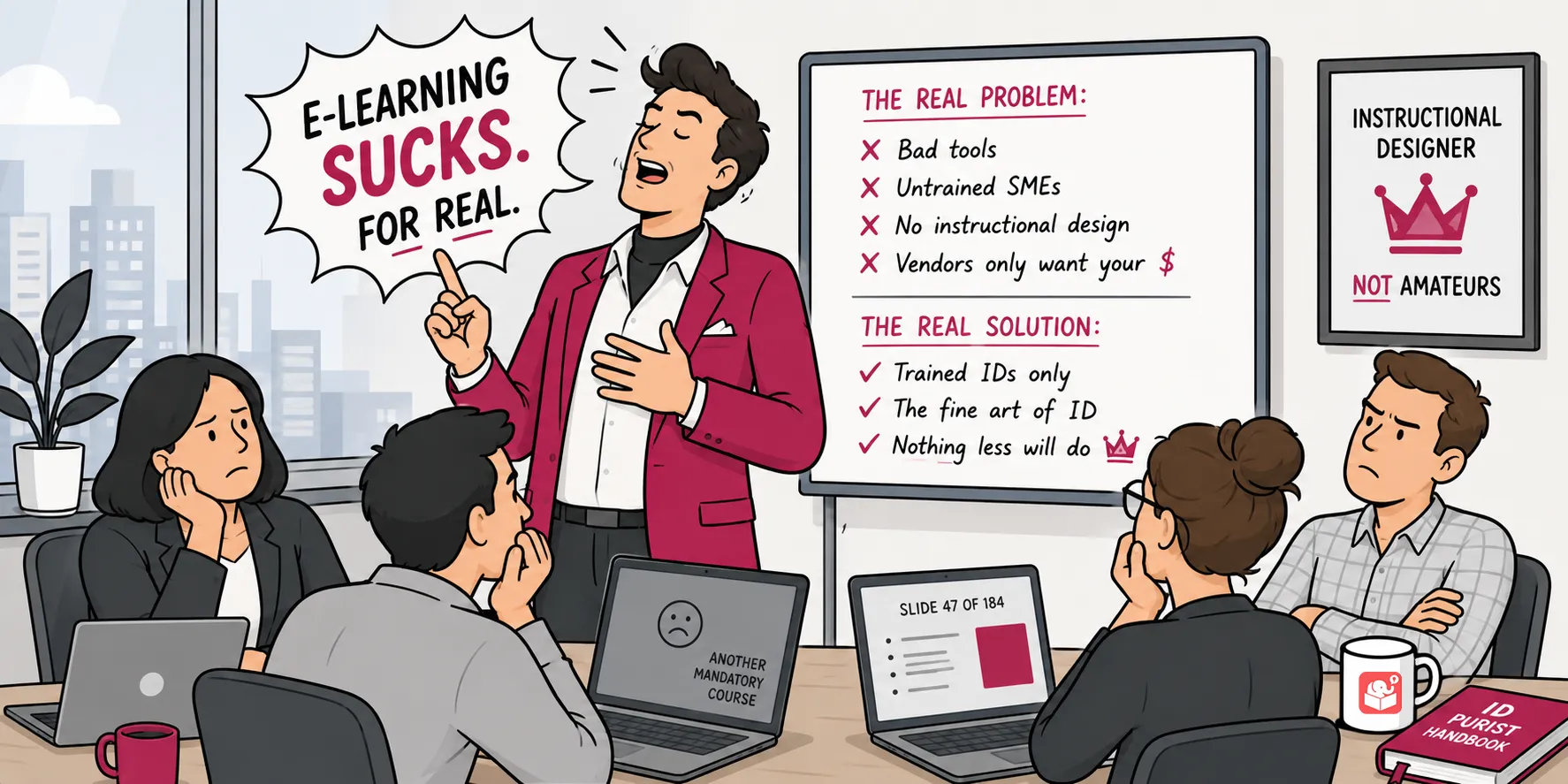
Despite all of the yammering from e-learning’s LinkedIn posse, the real reason boring e-learning keeps getting built has little to do with the software. Some folks blame authoring tools for opening the floodgates to bad e-learning. The argument goes that only trained instructional designers should build courses.
That’s elitist, and it’s just not true. E-learning was boring long the easy authoring tools existed. It just cost more to make, so there was less of it around.
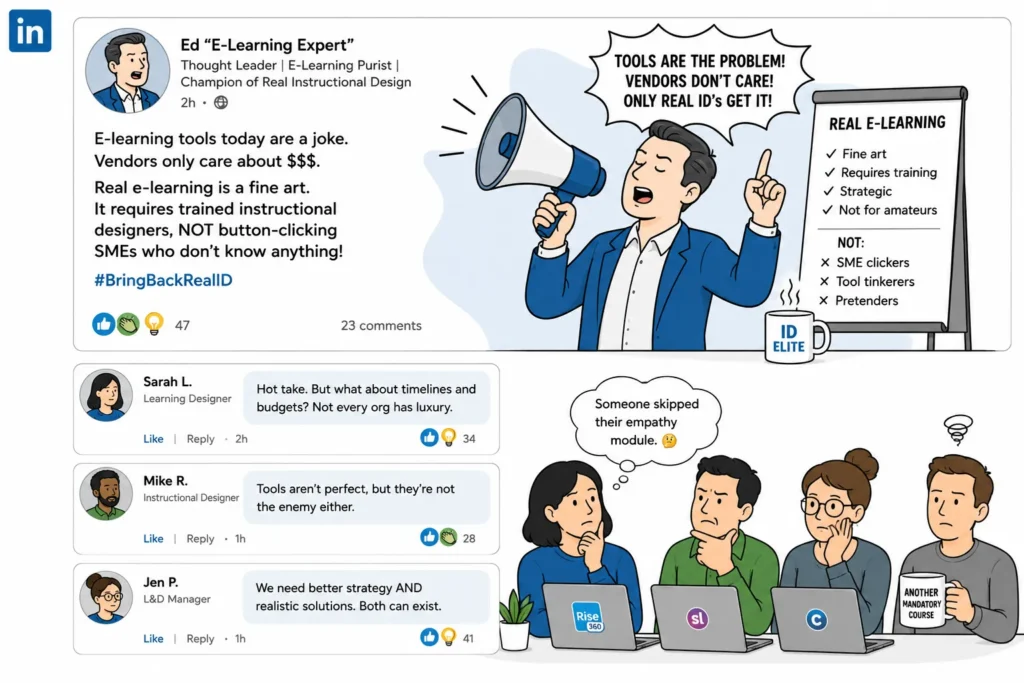
The old courses weren’t built by amateurs either. Instructional designers made them, and plenty were worse than what we see today. Tools don’t create boring courses on their own. They just make it easier to produce a lot of them, fast.
Where AI fits in: A lot of people are worried about AI taking their jobs. That’s a fair concern, and it’s worth taking seriously. But in this context, AI is less of a threat and more of a thinking partner for people who don’t have a lot of design experience.
If you’re an organization with one overworked developer and no instructional design background, AI can quickly point you toward better questions. What’s the actual goal here? Who are the learners? What should they be able to do after this?
Good AI tools are trained on sound performance consulting and instructional design thinking. They can steer an inexperienced team in the right direction faster than trial and error will.
Talk to course developers at big companies or small ones and you’ll hear the same story. Leadership buys the authoring software and calls it done. Nobody invests in training the team or teaching them to build better experiences. There’s no UX designer shaping the flow, no graphic designer building visuals that support the content.
Multimedia help? Rare. Access to a programmer? Also rare. Half the time, the people building courses aren’t even talking to whoever runs the learning management system.
Good e-learning takes more than good software. It takes a real strategy and a team that has what it needs to pull it off. What most organizations have instead is one or two overworked people with a long list of requests and not much backup. That’s the environment that produces boring courses. Not the software.
Where AI fits in: Can’t afford a graphics team? AI image and design tools have gotten good enough to help a solo developer produce visuals that don’t look like clip art from 2003. Need to think through your options on a project? Talk it through with an AI tool.
It’s decent at helping you see angles you might have missed. It won’t replace a real graphic designer or a seasoned instructional designer, but for teams working with very little, it raises the floor.
Ask most teams how to close a training gap and they’ll reach for content. Need to know something? Here’s a PDF. Here’s a video. Content is part of learning, sure, but it’s not the whole process.
Most e-learning I see is just content, often stuff that already existed somewhere else. Someone slaps it into a course, adds a ten-question quiz, and calls it done. That’s not teaching.
Content without context or practice doesn’t change what people do on the job. For content to actually work, it needs two things: 1) it needs to be meaningful and 2) the learner needs to practice and apply what they’ll do outside the course.
Most courses stop at sharing content and testing recall. There’s no scenario where the learner makes a real decision and sees what happens next. That’s the gap that makes the whole thing forgettable.
The learner finishes, gets the certificate, and moves on. Nothing changes. That’s why so many of these courses feel pointless. Because they are.
Where AI fits in: This is where AI can do some of its most useful work, and where it needs the most supervision. Organizations tend to equate knowing content with training.
AI, if you ask it the right questions, will push back on that. It understands the difference between information transfer and behavior change. Ask it to help you define a learning objective and it’ll ask what learners should do differently, not just what they should know.
That’s the right instinct. The risk is letting AI generate the content itself without much direction. You’ll get something that sounds like a course but reflects nobody’s real experience. Use AI to sharpen your thinking. Write the course from that thinking.
Treat it as an intern who can collect and organize your thinking. But make sure you’re the “your” in the thinking. 😊
If you want your e-learning to be effective, start with what your team actually has to work with. Push for real investment: training for your developers, design support, and time to build practice activities instead of content dumping.
Check your next course for two things: relevant context and a chance to practice. Fix those two things first and watch the boring problem clear up on its own. If you’re not there yet, knowing what’s missing is still useful. It tells you what you’re working around, and where to focus when the opportunity opens up.